


David Bentley Hart wrote this line in 2020, in a Commonweal essay.
“Contrary to conventional wisdom, Christianity has never really taken deep root in America or had any success in forming American consciousness; in its place, we have invented a kind of Orphic mystery religion of personal liberation, fecundated and sustained by a cult of Mammon.”1
Most people who encounter this quote may not know what “Orphic” means. The word gets omitted from the viral screenshot versions circulating around. Strip it out, and the diagnosis loses some of its precision. Hart is saying more than American Christianity is shallow or materialistic. He is pointing at a structure. The dominant popular form of Protestant Christianity that has molded this country’s religious imagination for two centuries is built the same way as an ancient Greek mystery cult that predates Jesus by half a millennium.
The question is whether he is right.
What the Orphics Actually Believed
The Orphic movement emerged in Greece around the sixth century BCE, named for the mythic poet Orpheus, whose descent into Hades and return supposedly gave him knowledge unavailable to ordinary mortals. What he allegedly brought back was a theology that broke sharply from mainstream Greek religion. Scholars still argue over how coherent a movement Orphism was, and the evidence is fragmentary, but the beliefs described below recur across enough sources to sketch it out.2
Where Homeric religion was public, civic, and communal (sacrifice, festival, obligation to the polis), Orphism was private, initiatory, and focused entirely on individual soul-destiny. The core belief was that the human soul was divine in origin, trapped in a corrupt body as punishment for some primordial fault. The Orphics coined a pun that crystallized the whole thing: sōma/sēma, body/tomb.3 The body was a prison. The world of matter was a place of contamination and exile. The goal of religious life was to escape it.
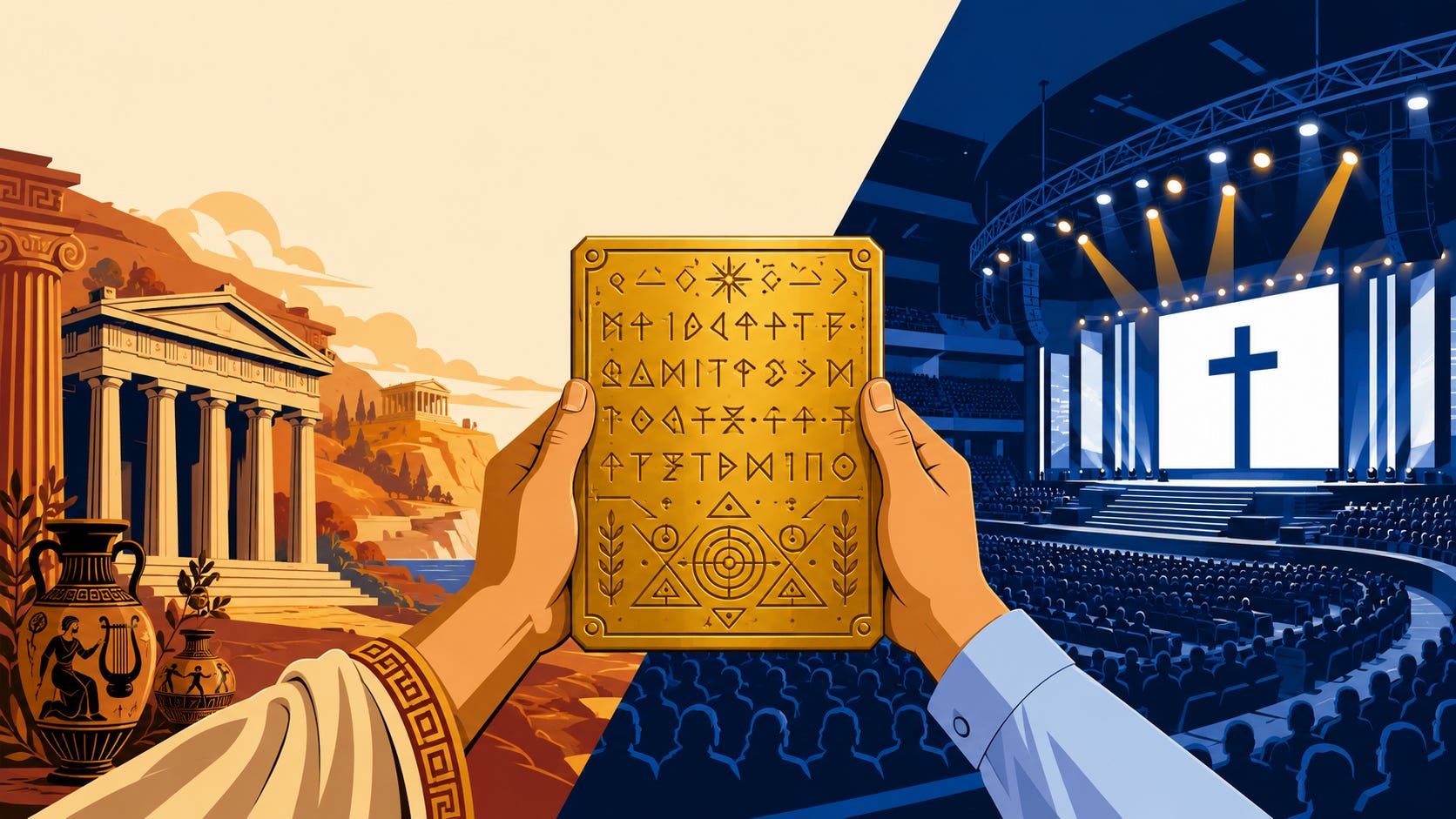
Salvation required initiation. There were formulas to learn, rites to perform, a priestly class who knew the procedures and guided you through them. Gold tablets buried with Orphic initiates in southern Italy and Crete provided detailed instructions for navigating the underworld, specifying which springs to drink from and which roads to take.4 The knowledge was esoteric, held by the community of the initiated and unavailable to everyone else. The uninitiated went to one fate; the initiated to another. The dividing line was the transaction. Had you received the right knowledge, performed the right ritual, secured your status with the right formula?
Sound a bit familiar?
Once liberated through the correct initiatory process, the soul would eventually escape the cycle of reincarnation and return to its divine source. This was salvation from the world. You were being extracted.
The Long Move Away
The early church existed inside the Hellenistic world, and the Hellenistic world was saturated with mystery religion. Inevitably, some of the vocabulary and conceptual ideas went along.
The most extreme version is Gnosticism, where Orphic logic dominates almost completely. Many Gnostics taught that the material world was created by a lesser, malevolent deity and that salvation meant the escape of the divine spark from matter back to its proper home. Individual initiation, secret knowledge (gnosis), and a sharp divide between the spiritually enlightened and everyone else.
The body and the world were obstacles.
The proto-orthodox tradition pushed back, and hard. Irenaeus of Lyon, writing in the second century, fought Gnosticism on exactly this point. His weapon was what scholars now call recapitulation theology. Christ came to recapitulate and renew all of creation. Irenaeus argued that the final state of creation would resemble its original form, a continual renewal of humanity through the Spirit, the whole cosmos restored.5 Salvation was participatory and cosmic. The physical body was important and history mattered.
Irenaeus won that argument, officially. Gnosticism was condemned. But the intellectual currents that produced it went underground, resurfaced in new configurations, and kept exerting pressure on Western Christianity’s evolving doctrine of salvation.
Augustine is the hinge. The most influential theologian in the Western tradition, he was a Manichaean for nearly a decade before his conversion, and Manichaeism was a close cousin of Gnosticism, built on a sharp dualism between light and matter, spirit and flesh. His mature theology rejected Manichaeism formally. But Platonism remained his intellectual root, and Platonism had its own very tenuous relationship with all things material. Plato’s philosopher ascends away from the cave, away from the shadowed world of matter, toward the eternal forms. Augustine’s great line, “our heart is restless, until it repose in Thee[1] ,” is beautiful, and it is also a profoundly Platonic formulation. The soul’s longing is figured as ascent, as a weight pulling upward against the drag of concupiscence and embodied life. The Hebrew instinct was quite different, with creation pronounced good, history as the arena where God is actually at work, the body as the site of resurrection. In Augustine, those emphases recede considerably. Individual soul-destiny moves toward the center of the story.
From there the trajectory is obvious. Anselm’s satisfaction theory introduces transactional logic, a cosmic debt incurred, an honor violated, a price that must be paid. Luther’s breakthrough is a personal anguish answered by a personal gospel. How do I find a gracious God? Justification by faith alone answers one man’s anguished question about his standing before the divine. None of this is Gnosticism, formally-speaking, but the architecture assembles piece by piece and when it reaches the American revivalist tradition, the Orphic structure reassembles itself with almost scary fidelity.
The American Version
American revivalism is where the pieces all click together. The anxious bench, the altar call, the moment of decision. Billy Graham in a football stadium asking tens of thousands of people to walk down the aisle and make it official. Bill Bright handing out Four Spiritual Laws on a tract. The Sinner’s Prayer. These are all initiation rites of a sort. The logic is identical to what the Orphic priests were peddling. A specific transaction, correctly performed, secures your status and changes your eternal destination. The mechanism is different, yes, but the architecture is largely the same.
The insider/outsider binary is faithfully reproduced in evangelicalism. The born-again experience marks a categorical divide between those who have received saving knowledge and those who haven’t. “Saved” and “unsaved” function basically the same way “initiated” and “uninitiated” functioned in ancient Orphic communities, as an ontological distinction. On one side, you possess the secret. On the other, you don’t, and your fate is categorically different.
The esoteric quality of Orphic knowledge has its own American evangelical parallel, and it is quite explicit. A significant strand of evangelical and fundamentalist Bible interpretation holds that scholars who are not themselves born-again and Spirit-filled cannot properly interpret Scripture. The claim has a root in Paul, who says the natural person cannot understand the things of the Spirit (1 Corinthians 2:14-15). The trouble starts when the doctrine settles into a rule about who gets a hearing. The uninitiated academic, regardless of credentials, cannot “rightly divide the Word.” Real truth is available only to those who possess the inner key. This is an extraordinarily convenient epistemological arrangement. It grants the initiated community complete immunity from all outside critique. No data, no historical evidence, no textual scholarship can touch their claims, because the challenger simply hasn’t been initiated and cannot know the truth. The Orphics would have recognized this strategy immediately.
The body and the world are problems. Mainstream evangelical eschatology, particularly in its dispensational forms, teaches that the world is winding down. The Rapture is the most Orphic idea in American Christianity. Souls of the initiated are extracted from corrupt matter before the final destruction. The world is a burning building, and the point is to get out before the roof falls in. Dispensationalists do teach a new earth eventually, but the sermons and the paperbacks sell the exit hard.
And then there is Hart’s “cult of Mammon,” which is structural. When salvation is organized entirely around individual status, when the whole religious enterprise reduces to securing your personal escape and optimizing your own standing before God, spiritual and material prosperity become logically equivalent. Both are individual goods. Both are what you receive for being in right standing with God. The prosperity gospel is a predictable outgrowth of American evangelicalism.6
The Misallocation
The genealogy above establishes what runs underneath most of what I write here. Western Protestant Christianity, and American evangelicalism in particular, has catastrophically misallocated much of its emphasis. The faith, as Jesus announced it, was about renewal and transformation, while the dominant tradition built from it has organized itself around something else entirely.
The Sermon on the Mount is a description of reordered life in community. Matthew 25 is a judgment criterion organized entirely around what you did with and for other people. The Hebrew prophetic tradition, from which Jesus drew continuously, was concerned with whether the community was living according to covenant obligations to the poor, the widow, the stranger. These are undoubtedly the main current for Jesus.
What American evangelicalism largely produced instead was a theology of transaction. Debt incurred, penalty paid, account cleared. Once-for-all, personal, private, secured by the right formula at the moment of conversion. The ethical, communal, and cosmic dimensions of salvation did not entirely disappear from view, but they were demoted to applications or implications of the real thing, rather than constitutive of it. The result is a version of Christianity organized around what you believe over what you become, around the transaction rather than the transformation.
The Eastern Orthodox tradition largely avoided this mistake, and so did Irenaeus and the Cappadocian Fathers. But in the Western church, after Augustine and Anselm and the long arc of revivalism, transaction became the default and it is a default with very real consequences.
Predictable Results
Use the word “cultic” carefully, because it is easy to reach for it as an insult and harder to use it as a descriptor. Used precisely, though, it is more serious than the typical vocabulary of “toxic” or “authoritarian.”
Religious systems organized around exclusive saving knowledge, a sharp boundary between who is in and who is out, a priestly class controlling access to the initiatory rites, and a cosmology of escape rather than transformation describe something about mainstream American evangelicalism that standard critical vocabulary doesn’t quite reach. Christian nationalism and MAGA Christianity are downstream of the same structure. The underlying architecture is salvation as a private transaction that produces a private benefit for the individual soul, managed by specialists, secured by a formula, with the world functioning mainly as backdrop for the real drama of eternal destinies being sorted.
That structure tends to generate predictable results, and we can identify some of them readily. It generates a priestly class with enormous authority over access to saving knowledge. The celebrity pastor problem reproduces itself decade after decade, denomination after denomination, for a reason. Mark Driscoll dismantled one church and then went and built another with the same authoritarian architecture intact.7 Doug Wilson presides over an enclave in Moscow, Idaho, where the theological system and the culture of male dominance are mutually reinforcing, and the system supplies its own theological cover. Having co-founded the Communion of Reformed Evangelical Churches, he is also effectively his own accountability structure, which is handy.8
Josh Howerton told women from the pulpit at Lakepointe Church in Texas to “stand where he tells you to stand, wear what he tells you to wear, and do what he tells you to do,” referring to a husband’s wishes on their wedding night (the second half of a bit that first told grooms to follow their brides’ wishes), and the congregation applauded[2] , in a room where the pastor is the gatekeeper of saving knowledge and his authority is nearly uncontested.9
Mike Winger commands more than a million YouTube subscribers by positioning himself as a trustworthy guide to what Scripture actually means.10 That is a perfectly Orphic function; the initiated expert mediating sacred knowledge to those who need the interpretation provided for them. That his conclusions on matters like the egalitarian/complementarian debate, or on any number of political questions, are wrong with great confidence doesn’t diminish the structural role.
These aren’t equivalent figures; some are far more harmful than others. But they all operate within the same logic. The religious specialist controls access to the truth, and the community’s access to God runs through him. I have known evangelicals whose faith I would hold up against anyone’s, but my target here is the dominant public expression of the tradition, its institutions and its theology.
I, admittedly, occupy a version of this space too. I am not controlling access to anything, and anyone can read this essay or not, but I do position myself as a reasonably studied voice in this space. I think the difference is that I am trying to dismantle the gatekeeping mechanism altogether. Whether I am succeeding in my own small way is a reasonable question. The Orphic structure is so deeply embedded in the entire institutional tradition that even critics can unconsciously reproduce its habits. I endeavor to remain honest about that possibility.
The system also generates a community organized around membership criteria rather than transformation. The question is “did you make the transaction?” Once you did, your status is secured regardless of what follows. This is precisely what Dietrich Bonhoeffer meant by cheap grace: “grace without discipleship, grace without the cross, grace without Jesus Christ, living and incarnate.”11 That diagnosis is baked in.
And the system generates a political theology with no vocabulary for corporate sin, structural injustice, or the common good, because those categories require a salvation with a telos beyond the individual. When salvation is personal escape, the neighbor becomes either a conversion opportunity or an irrelevance. The obvious tell for this inclination is hiding in plain sight.
So many of these pastors and their audiences use the word “woke” as a pejorative. The word, in its original sense, simply means being alert to social injustice, bigotry, and prejudice. The reflexive contempt for it reveals exactly where the priorities of escape-oriented religion land when social justice issues arise. The irony here is thick. Scripture tells believers to wake up again and again. Jesus closes the parable of the ten virgins by telling his hearers to stay awake (Matthew 25:13), and Ephesians quotes what looks like an early hymn that begins with a call to the sleeper to wake up (Ephesians 5:14). Many of the same pastors and their audiences hurl “woke” at progressives and liberals as an insult, which also implies alertness to injustice is a character flaw. [3]
Hart’s line about the cult of Mammon is the endpoint here. When the system is organized around personal benefit and individual destiny, wealth-worship (spiritual and/or material) fills the vacuum that God and neighbor were supposed to occupy.
What Was Always There
The early Christian tradition that got crowded out by transactional belief was quite real, and it ran deep. From Irenaeus through the Cappadocian Fathers through the Eastern church’s doctrine of theosis, salvation as participation in the divine life, a transformation of the whole person in community, oriented toward the renewal of creation. The body matters because the resurrection of the body is the point. History matters because God is at work in it and through it, or better yet in and through Him. The neighbor matters because you cannot be saved in isolation from the human community you are in. That community can include the institutional church, of course, and it reaches well beyond it, since every human being is made in God’s image (Genesis 1:27).[4]
Jürgen Moltmann made the argument in Theology of Hope that Christianity is “eschatology, is hope, forward looking and forward moving, and therefore also revolutionizing and transforming the present.”12 The notion of the resurrection is the first evidence of a new creation coming. The goal is the transformation of the world itself, the whole cosmos drawn into the life of God. Walter Brueggemann’s reading of the Hebrew prophets places the entire prophetic tradition in direct conflict with the Orphic logic I’ve described here. The prophets are voices confronting the community with its failures toward the poor, the widow, the stranger.13 These are the concerns of a faith that believes God is engaged with history and with the people in it.
The problem with the Western evangelical tradition isn’t that it has said nothing true. It has. The problem is that it organized everything around the wrong center; the wrong focus and then defended that mistake with increasing ferocity as others kept producing evidence against it. You cannot run Matthew 25 through the transactional theological machine Evangelicalism has built. The passage will not fit. It is stubbornly about what you did concerning other people’s real, tangible needs, and no amount of theological contortion or nuance makes it say otherwise.
ENDNOTES
1. David Bentley Hart, “Three Cheers for Socialism,” Commonweal, February 24, 2020. In my experience, memes and screenshots of the idea that circulate online tend to paraphrase and soften it, and “Orphic” is often the first word to go.[5] The full version, as reproduced here, is available at www.commonwealmagazine.org/three-cheers-socialism. Hart’s essay goes on to draw a political conclusion from this diagnosis. I am borrowing the diagnosis. Readers can follow Hart to his prescription or not, and the diagnosis stands either way.
2. On the debate over how coherent ancient Orphism was, see Radcliffe G. Edmonds III, Redefining Ancient Orphism: A Study in Greek Religion (Cambridge University Press, 2013), which argues for a loose and fragmentary picture, and Alberto Bernabé, Poetae epici Graeci: Testimonia et fragmenta, Pars II: Orphicorum et Orphicis similium testimonia et fragmenta (Munich and Leipzig: K. G. Saur, 2004-2007), whose edition assumes more internal consistency.
3. The sōma/sēma formulation, body as tomb, is associated with Orphic and Pythagorean traditions and is preserved in Plato’s Phaedrus (250c) and Gorgias (493a), where Plato cites unnamed “wise men” as its source. In the Cratylus (400b-c), Socrates says it is most likely that the Orphic poets gave the name. It remained one of the most compact expressions of body-soul dualism in the ancient world.
4. The Orphic gold tablets (lamellae), recovered from burial sites in southern Italy, Crete, and Macedonia, date from the late fifth century BCE through the second century CE. Graf and Johnston call them Bacchic tablets, since their owners were initiates of Dionysiac mysteries whose myths drew on poems ascribed to Orpheus. For accessible scholarly discussion, see Fritz Graf and Sarah Iles Johnston, Ritual Texts for the Afterlife: Orpheus and the Bacchic Gold Tablets (Routledge, 2007).
5. Irenaeus, Against Heresies, especially 3.21, 5.14, and 5.21. The recapitulation (anakephalaiōsis) theme runs through these chapters, arguing that Christ sums up and restores what was lost in Adam, not by escaping creation but by renewing it from within. For Irenaeus’s anthropology, see John Behr, Asceticism and Anthropology in Irenaeus and Clement (Oxford University Press, 2000).
6. Kate Bowler, Blessed: A History of the American Prosperity Gospel (Oxford University Press, 2013). Bowler traces the movement to New Thought and the Pentecostal healing revivals and argues that it both reflects and shapes the religious culture around it.
7. On Mars Hill and its aftermath, see Kate Shellnutt, “Former Mars Hill Elders: Mark Driscoll Is Still ‘Unrepentant,’ Unfit to Pastor,” Christianity Today, July 26, 2021 (updated July 28), which reports a public statement from 41 former Mars Hill elders urging Driscoll to step down from The Trinity Church, which he founded in Scottsdale in 2016, two years after he resigned. Mars Hill dissolved after his resignation in October 2014. See also Christianity Today’s podcast The Rise and Fall of Mars Hill (2021).
8. Doug Wilson co-founded the Communion of Reformed Evangelical Churches (CREC) in 1998, according to Associated Press reporting (for example, “Defense Secretary Pete Hegseth belongs to an archconservative church network. Here’s what to know,” August 2025). His church, Christ Church of Moscow, Idaho, is the network’s flagship congregation.[6] On accountability and documented abuse cases involving Jamin Wight and Steven Sitler, see Josh Shepherd, “Deacon at Doug Wilson’s Church Indicted on Possession of Child Pornography,” Roys Report, May 4, 2022, which summarizes both cases, and the CREC presiding ministers’ report on the Sitler and Wight cases (August 15, 2017). Wilson recused himself from the CREC’s 2015 inquiry.
9. Josh Howerton, sermon at Lakepointe Church, Rockwall, Texas, late February 2024. Reported and analyzed by Sheila Wray Gregoire at Bare Marriage and covered across evangelical and post-evangelical media, including Rebecca Hopkins, “Josh Howerton Facing Backlash for Comments Some Say Perpetuate ‘Harmful’ Tropes About Women and Sex,” Roys Report, April 1, 2024. Howerton said the line was half of a joke and accused the clip’s poster of selective editing, and he apologized for “careless words” in a sermon on April 7, 2024, while maintaining that it was a joke.
10. Mike Winger, BibleThinker (biblethinker.org; YouTube channel @MikeWinger). His Women in Ministry series, published in thirteen videos from March 2022 to March 2024 and running more than thirty hours, presents the complementarian case and drew a lengthy published response from the egalitarian authors Andrew Bartlett and Terran Williams, summarized by CBE International.
11. Dietrich Bonhoeffer, The Cost of Discipleship (1937; English translation by R. H. Fuller, New York: Macmillan, 1959). The quoted phrase is from the opening chapter, “Costly Grace,” 35-36.[7]
12. Jürgen Moltmann, Theology of Hope (1964; English translation by James W. Leitch, Harper & Row, 1967), 16. Full sentence: “From first to last, and not merely in the epilogue, Christianity is eschatology, is hope, forward looking and forward moving, and therefore also revolutionizing and transforming the present.”
13. Walter Brueggemann, The Prophetic Imagination (Fortress Press, 1978; 40th anniversary edition, 2018). Brueggemann’s central argument is that the Hebrew prophets represented an “alternative consciousness,” a sustained challenge to what he calls the “royal consciousness” that organizes religion around power, wealth, and the comfort of those already in possession of both.
[1]Restored Pusey’s wording. Pusey reads “our heart is restless, until it repose in Thee.” Other translations read “our hearts are restless till they find rest in Thee.” “Finds its rest” blends the two, and a blend inside quotation marks reads as a misquote. Revert if you’d rather use another translation in full.
[2]Small grammar fixes in this passage and the next paragraph: a comma after the parenthetical, a comma in place of the semicolon before the appositive (”the initiated expert...”), and the typo “usae.” Revert any you meant.
[3]Your note asked for more on the irony of “woke.” This is my draft. It rests on two passages I could verify and leaves out the word’s origin so it doesn’t need another endnote. Adjust freely.
[4]Your note about the community, built from your own points: the church can be part of it, it isn’t limited to it, and everyone bears God’s image.
[5]Reworded to match your note that the circulating versions are memes and paraphrases. It is now framed as your observation, since I couldn’t find an example to cite.
[6]I replaced “NBC News and Religion News Service” with the Associated Press, which is the source I actually confirmed. Also worth a look: the body says he is “effectively his own accountability structure,” and this note says he recused himself from the 2015 inquiry.
[7]Confirmed the Macmillan 1959 edition and pp. 35-36 through a secondary source. Check the comma after “Jesus Christ” against your copy, since printings differ.
While I’m reading this sitting comfortably on a couch with my feet up and drinking a good cup of coffee, internally I am jumping up and down for joy at this paradigm-changing understanding. I had long intuited strands of what you explain here, but never had the history and architecture portrayed this clearly. I managed somewhat successfully to explain to decades-long friends and a few relatives (who asked) why I left the evangelical stream. I grew up in the EV structure and spent 65 years within it. THIS is a welcome view that encompasses the questions, disillusionments, and frustrations I had in my journey away from that unfulfilling and stultifying stream and toward a deeper relationship/transformation in my walk with God. Have now found transformative community among a group of Methodists known for their physical, emotional, and spiritual (if they desire) support of unhoused and less advantaged folks of our large metropolitan city. Thank you for this.
In conjunction with your other essay on “The Gospel According to Whom” this is a day’s theological exploration well-spent!
I especially appreciate your reference to Moltmann’s discussion of eschatology. Based on his work, I developed an idea of eschatology NOT as the theology of last things — but as the theology of LAST-ING things. In other words: our legacy. I wrote a couple of papers on it in grad school — but (surprise!) the profs were never as stoked about it as I was!