


Part Two: What the Fire Is For
Edwards returns to the mantel, sets a hand on the leaning stack as if to steady it, and does not sit. “You left a debt earlier,” he says. “You would sign that God is sovereign, that man cannot save himself, that the glory of God is the end of all things. The fourth you would word, in your phrase, a wee bit different. I have been waiting an hour to be told how.”
“Ye have a memory like a ledger.”
“It is the only kind I was issued.”
“The Scriptures, then.” MacDonald sits forward. “Ye said they’re to be wrestled with and never lightly dismissed, and I’d not take back a word. Here’s my difference. Ye read them as a lawyer reads a statute, for the doctrine ye can build and defend. I read them as a child reads a letter from his father, for the Voice behind the words, and I’d trust the Voice over any system I could build from the letters.”
“A lawyer,” Edwards repeats, without heat. “I have been called worse this evening.”
“I mean no insult. Ye were a great lawyer. The greatest the country made. But a statute canna love ye, and a father can, and I think the Book is more the second thing than the first.”
“And when the letter says a hard thing? When it speaks, as it does, of a fire that is not quenched, and a worm that does not die?”
“Then I ask what a father means by it, no what a prosecutor could prove from it.” MacDonald spreads his hands. “I wrote that faith in Christ is no the believing of true things about him. It is obedience. A faith which can have no existence except in obedience. Do the will, and ye’ll know the doctrine. That was the very sermon that cost me Arundel, ye’ll recall. I said the man who obeys knows more of God than the man who only subscribes, and the deacons heard a threat to the subscribing.”
“They were not wholly wrong to,” Edwards says. “For if knowledge follows obedience, then the test of a doctrine becomes the life it produces, and a man might set aside a true thing because it sat ill with him, and call the setting-aside obedience.”
“He might. And a man might hold every true thing in perfect order and be, in your own word, a whited sepulcher, correct and dead. Ye wrote a whole book to say so. Religious Affections. Ye spent four hundred pages proving that a man can have the doctrine entire and the heart untouched.”
Edwards is quiet a moment, because this is his own argument handed back to him.
“I did write that book,” he says.
“Ye did. And I’ve never understood how the man who wrote it could then make so much ride on getting the propositions exactly square. Ye proved the propositions werena the thing, and then ye guarded them like the thing.”
“Because a false affection is worse than a cold one,” Edwards says, and now there is some iron in it. “A man moved to the depths by a God who is not there is not nearer heaven than the man who yawns. He is further. The German critics your deacons feared, if I understand you rightly, taught men to feel exquisitely about a Scripture they had first emptied of its authority, and that is the warm heart over the untrue thing, which is the very ruin I spent my life warning against.”
“Now that,” MacDonald says slowly, “is the best case against me I’ve heard, and it’s yours, and I’ll have to carry it a while.” He is quiet. “I’d only say the authority I obey is a Person, no a text, and the text is the truest witness we have to him, which is a high place to give it, just no the highest. The highest is him.”
“On that,” Edwards says, “I do not think we differ as much as your deacons supposed, nor as much as mine would have liked.”
“No. I begin to think we were both fired for the same sentence, said with two accents.”
“Spoken like a Scot, which is to say at length.”
“Spoken like a Scot, which is to say correctly.”
He takes a scrap off his sleeve, studies it, and puts it down. “Before you tell me I conceived hell amiss, I’d like you to consider the sermon that actually seems to trouble people.”
“The End of the Wicked Contemplated by the Righteous.“
“Revelation eighteen and twenty. The saints in glory rejoice at the destruction of the wicked.” Edwards says it evenly, because he wrote it evenly. “I didn’t write that lightly. They will have, and I’ll quote myself, no love nor pity to the damned as such.“
It is MacDonald who takes a long moment now. “I’ve read it, Jonathan. I have to be forthright with ya, I did not enjoy it.”
“You were not meant to enjoy it. The saints were.”
MacDonald raises an eyebrow. “Is that a comment on my spiritual standing?”
“I make no comment on your standing, Mr. MacDonald. I observe only that the saints of the sermon were to rejoice, that you by your own testimony did not, and that a careful man draws his own inferences for himself.”
“That’ll be the Scot in me, then. We enjoy very little. It’s the climate.”
“I had noticed.”
MacDonald gets up, because he does his best arguing on his feet, and walks to the end of the long table, where he rests his knuckles on the wood. “Here’s my difficulty, Mr. Edwards. Your saints are conformed to Christ in their affections. You say so even. And in that same sermon you say Christ, right now, stands at the door and knocks; and ceases not, although sinners for a long time refuse him. Revelation three and twenty, I’d think.”
“It is.”
“That’s a letter to Laodicea, Jonathan, you know. A church. Lukewarm folk inside the walls who thought themselves rich and in need of nothing. It’s no a verse about the heathen at the gate.”
Edwards inclines his head, and when he speaks it is with the unhurried completeness of a man laying a foundation. “I concede that the letter was addressed to a church, Mr. MacDonald. But a church, as I was at some pains to maintain in Northampton, and to the cost of my situation there, may be full of persons who possess the name of Christians and nothing besides; and the Laodiceans, who said that they were rich and increased with goods and knew not that they were wretched, and miserable, and poor, and blind, and naked, were precisely such persons; and I did not think it a violence to the text to hear the knocking of Christ at the door of the unconverted even within the visible church.”
MacDonald considers this, and to his credit he doesn’t pretend not to have. “That’s a fair defense. I’ll take it whilst standin’ here.” He straightens. “And it helps me more than it helps you, besides. If he knocks on the unconverted inside the church, then he’s a knocker by nature, and I’d ask what makes him put down his hand at the edge of the grave. So which Christ are the saints conformed to then? The one who wept over Jerusalem, or the one who stopped?”
“I answer that sufficiently in the sermon. Now they are capable subjects of mercy. Then they are not.”
“Capable subjects of mercy.” MacDonald tastes the phrase. “Is that a thing a man can stop being? I don’t know how you’d make him less than he is. He’s a man. He’s the kind of creature mercy is for.”
Edwards turns his chair a quarter turn more to face him directly. “You need the will to follow the sight.” He says it carefully, testing each word before he puts weight on it. “I wrote that the will always is, as the greatest apparent good is. I haven’t changed my mind thus.”
“I hoped you hadn’t. It’s the best argument I’ve got.”
Edwards looks at him rather coldly.
“Let me lay it out plain, since ye’ll want it in order.” MacDonald counts on his fingers. “One. The will goes where the best thing it can see points. Your words. Two. A man in the dark loves the dark because he’s no seen the light, and what’s missing is the seeing, no the wanting. Three. Ye wrote a whole sermon on where the seeing comes from. A divine and supernatural light, imparted immediately, no got by reasoning, given. And four. Ye said it could be owing only to the gracious distinguishing influence and revelation of the Spirit of God.“
“That I did.”
“The distinguishing, Jonathan. That’s the word I’m after. God gives the sight to some and holds it back from others, and then burns the others simply for no having it. What manner of God be that one?”
“He holds them to account for what they love, Mr. MacDonald.” Edwards does not raise his voice, but he noticably picks up speed, as a man does on a downhill road he has walked many times. “The reprobate love the darkness; the Scripture says so; no force is put upon them; they are merely unmoved by a beauty which they have not been given eyes to perceive; and the fault is theirs nonetheless, because the loving of the darkness is wholly theirs.”
“Then it’s a hard sort of blame, then, for a man who’s blind.” MacDonald scratches his beard inquisitively. “Ye wrote, There is a difference between having a rational judgment that honey is sweet, and having a sense of its sweetness. Ye canna argue a man into tasting. Somebody has to put the spoon in his mouth. The only question is whether the One wi’ the spoon goes round every table or only some.”
“God permits sin. He does not cause it.”
“A man stands at a well wi’ a rope in his hand,” MacDonald says. “He has all the time there is, and he knows the lad’s name, and the lad’s going under. And ye’d tell me he then permitted it.”
“There is a distinction between the decretive and the permissive will that has satisfied better minds than yours or mine.”
“There’s a distinction between a distinction and an answer.”
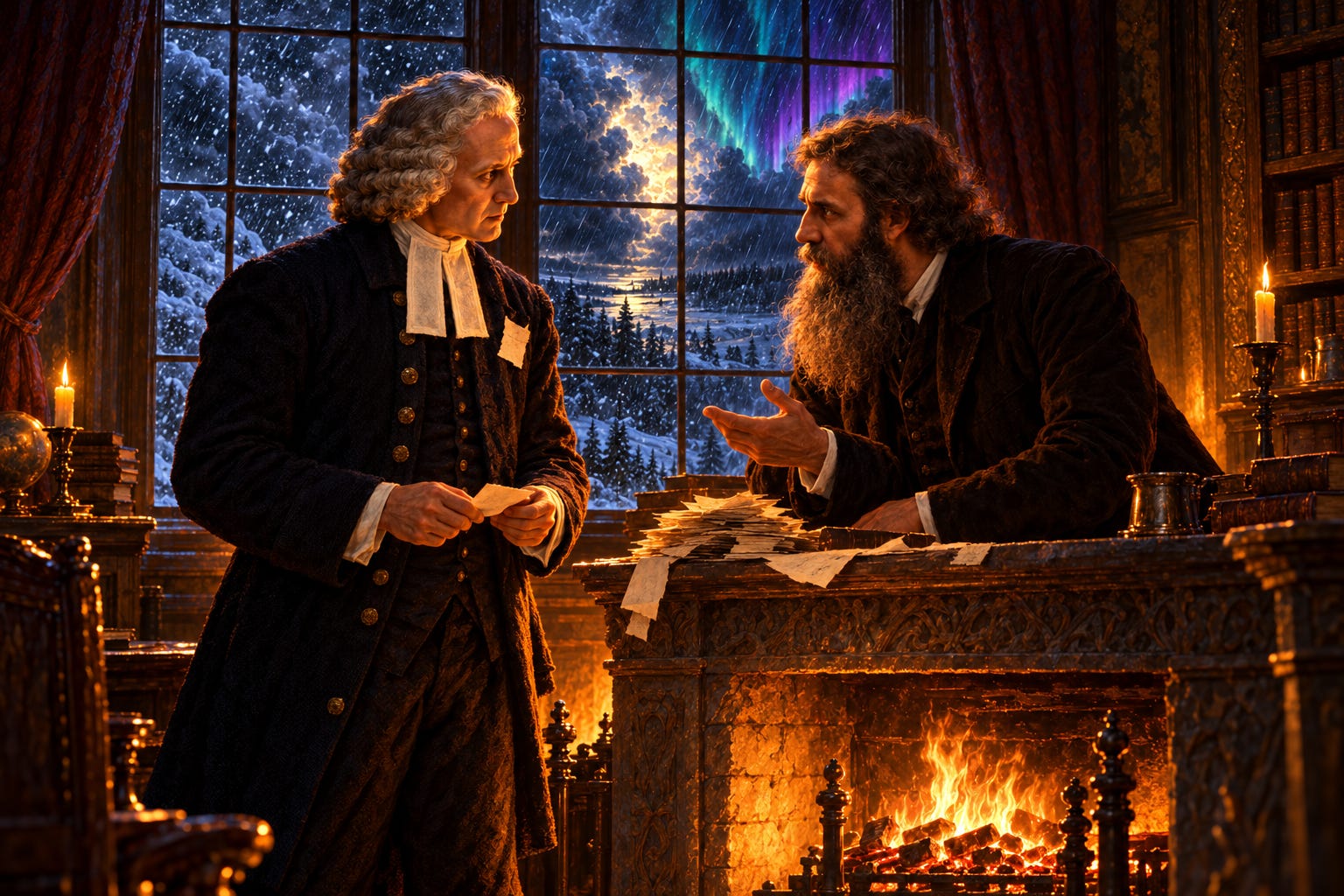
Edwards is silent, in the manner of a man assembling a curated reply.
“Ye wrote that the beams of glory come from God, are something of God, and are refunded back again to their original. Every beam, Jonathan. A burn doesna ask the way to the sea. It does what burns do.”
“A beam may be refused, can it not?”
“By a creature that was never given eyes to see it? Ye call that a refusal?”
Edwards does not answer this time.
“Then I’ve found the quarrel. It sits in whether he withholds.”
“Whether he may,” Edwards says.
“Whether he would.”
“And there’s your own irresistible grace,” MacDonald adds, because he cannot help himself. “John six and forty-four. No man comes unless the Father draws him, and when the Father draws, the man comes. Good. I’ll hold ye to it. John twelve and thirty-two. ‘And I, if I be lifted up from the earth, will draw all men unto me.’ All, it tells us.”
“All without distinction, Mr. MacDonald, which is a different thing from all without exception.”
“Aye. The only arithmetic in the world where a man’s sums get him ordained. Or fired.”
“It has been remarked.” Edwards folds his hands carefully. “I will remind you that the apostle himself asks, at the ninth of Romans, ‘What if God, willing to show his wrath, and to make his power known, endured with much longsuffering the vessels of wrath fitted to destruction?’”
“What if,” MacDonald says. “Ye’ll notice it’s a question. And two chapters on he gives the answer. ‘God hath concluded them all in unbelief, that he might have mercy upon all.’”
“Which all is it then?”
“The same all, in the same sentence, wi’ the same Greek. Ye’ll have to tell me which half of it is being kept in the dark.”
“I’ll say it plain, since ye’ve been too well mannered to ask,” MacDonald says. “I believe the love of God will bring every one of his children home. Nothing left over, nothing left out. The restoration of all things, even those vessels fit for wrath. It be God’s restoration; his all in all.”
“Apokatastasis,“ Edwards says, as one might mention a rare disease. “Origen’s word, and one condemned.”
“Peter’s word. Acts three and twenty-one. ‘The times of restitution of all things.’ And Origen was condemned at a council in the sixth century, and the historians canna agree what that council did there, and I’ll no hang my eternity on a quarrel among irritable bishops.”
“The testimony of the church is weightier than a historian’s doubt, is it not.”
“That Gregory fellow is a saint in East and West alike, and he held it. The church’s testimony is no so unanimous as ye’d like it to be.”
“Saints have erred. Saints do err.”
“Aye. Even the ones wi’ an abundance of footnotes.”
“Then you will give me the word,” Edwards says. “Matthew twenty-five and forty-six. Kolasin aionion. Eternal punishment. And in the same verse, in the same breath, with the same adjective, zoen aionion. Eternal life. If the word limits the one, it limits the other and I will not shorten the life of the saints in order to win a battle of words.”
MacDonald brightens like a man who has waited a long time at a station for one particular train. “I’d never ask ye to. Look at the noun. Kolasis. Aristotle kept two words for punishment, ye’ll ken. Timoria is the punishment for the satisfaction of the one who punishes. Kolasis is the punishment for the good of the one who’s punished. Our Lord picked the second one.”
“The distinction is Aristotle’s, Mr. MacDonald, and Aristotle was a heathen.”
“So was the Greek he wrote it in, and ye’ve no complained about that, do ye.”
“I have indeed complained about it privately.” Edwards considers. “And the later writers used the two words without much care for the difference. Usage does not always keep them apart.”
“Aye, that’s fair, and I’ll grant it’s a lamp more than a hammer. But aionios. It’s of the age, Jonathan. Pertaining to the Age. Life of the Age. Fire of the Age. It’s God’s own. The fire is everlasting because he is himself, and he is the Consuming Fire. Let the fire be everlasting. Then ask what it’s burning that entire while.”
“He goes away into everlasting punishment.”
“Into the fire. And who’s in it? It doesna say the man is everlasting too. It says the fire is.”
“I hold that the text will not support what you ask of it.”
“And I hold ye’re asking it to say what it never said.”
“You take the teeth out,” Edwards says, “and I confess the omission distresses me greatly. Everyone gets home, and I should like to know what the warning was for.”
“The teeth are all there, with assurance.” MacDonald’s voice changes. “I wrote that He shall be cast into the outer darkness who hates the fire of God. I wrote that he shall not come out till he has paid the uttermost farthing. And I wrote that no hell will be lacking which would help the just mercy of God to redeem his children. My quarrel is with the lock on the outside of the door. They say I went soft. I’d be flattered if it were accurate.”
“It seems you’ve made the warning but a formality.”
“A man doesn’t need the door locked to be afraid of the burning.”
“And I’ve never got past this one,” MacDonald goes on, more quietly. “Ye say the saints will rejoice in the justice, because they seeing God so strictly just will make them value his love the more. The lost are the dark behind the lamp, so the saved can read the mercy by it. Then the lost are a light for the saved to read by. And if that’s the use of them, Jonathan, more lost means more light. Ye’d be wanting a larger hell then.”
Edwards is on his feet. He does not appear to have decided to stand.
“Sir.” The word comes down flat and hard, and the room goes quiet around it the way a field goes quiet before heavy weather. Edwards has not raised his voice, which in him is more alarming than shouting would be in another man. “You will not put that in my mouth. You will not. I sat twelve hours of the day in that study, and on the Sabbath I stood before the faces of children I loved as I loved my own and told them of the pit, and I went home and could not eat. I have wept over this matter in places you will never be shown. I preached the terror of that place because I could not find in the whole of Scripture a door by which to carry them out of it, not because I wanted the door shut, and if you imagine that I totted up the damned like a merchant counting lamps to read his ledger by, then you have read my words and understood nothing of the man who bled to write them. I said of the doctrine that they hate to believe it, and cannot bear it should be true, and I said it because I felt the loathing in myself, every day of my life, and I would not let myself off on that account, because I did not think a hard thing became false merely because it was hard to a tender heart. You have a hope. I do not mock it. I looked for it with more diligence than you will ever credit, on my knees, for years, and I did not find it, and you will forgive me, sir, if I do not count it a small or a comfortable thing that I should have spent my one life in the looking and come up empty.”
He stops. He looks at his hands as though they belonged to someone more emphatic than he intended, and then he sits abruptly and smooths his coat, as the scraps stir faintly on the mantel behind him.
“I beg your pardon,” he says. “That was not in my manuscript.”
“Wheesht. That was the best thing ye’ve said, in truth,” MacDonald says quietly.
“It was not in the manuscript, and I cannot account for it.”
MacDonald sits. “Ye preached a sermon on that very subject, I’m told. Sermon nine. The Spirit of Charity the Opposite of an Angry or Wrathful Spirit.“
“I did. It distinguished the anger that sins from the anger that does not, upon four heads, the nature, the occasion, the end, and the measure.” Edwards closes his eyes briefly, like a man consulting an internal ledger. “I have been auditing myself against it for the last minute, and I am obliged to report that the measure was found to be excessive.”
“And the occasion?”
“The occasion was adequate.”
“Aye. I’d have said so.”
For a while the only sound in the room is the lamp. Then MacDonald says, trying not to smile and failing, “You wrote another thing in The End of the Wicked. About heaven. Then there will be no remaining difficulties about the justice of God.“
Edwards studies the grain of the table for a long time.
“I did write that.”
“And here we are.”
“I have noticed one,” Edwards says.
MacDonald laughs again, properly this time, and after a decent interval Edwards joins him. “I preached sixteen sermons on that chapter of Paul’s,” he says. “The one about knowing in part. I assumed the part would be substantially smaller by now.”
MacDonald gets up, takes a scrap off the leaning, fluttering stack on the mantel, carries it to the lamp, and squints. “Can anyone read this?”
“Sarah can.”
“I’d like to meet her.”
A looseness comes over Edwards’s face, a slackening about the eyes that appears to take him by surprise. “I wrote of her once,” he says, “before I had spoken a word to her. I was twenty. I had heard of a young lady in New Haven, and I set down what I had heard, and I have never been able to improve upon it.” He looks at the lamp rather than at his guest. “They say there is a young lady in New Haven who is beloved of that Great Being, who made and rules the world, and that there are certain seasons in which this Great Being, in some way or other invisible, comes to her and fills her mind with exceeding sweet delight.“
He stops. MacDonald says nothing, which for a Scot is a rare courtesy.
“I understated her,” Edwards says. “I would not say so if I did not mean it. I do not oft exaggerate.”
“That’s the most poetry I’ve heard ye speak.”
“It was a young man’s prose.”
“Louisa would have liked her. The two of them would have talked about us in the next room, and we’d no have enjoyed it.”
“I have never doubted it,” Edwards says, and the corner of his mouth moves of its own accord.
He turns a scrap over without reading it. “They voted me out over the Lord’s Table. Whether it was for people the gospel had actually changed.”
“Mine cut my pay to take a hint. They said I had German theology.”
“I confess I do not know what German theology is.”
“Nor did the deacons, which is what made it so useful. To a Sussex deacon in 1853 it meant any book printed in Germany that none of them had read or could. Mostly it meant the critics, who’d begun treating the Bible as a book that people wrote, and Schleiermacher, who’d made religion a matter of the feelings, and the philosophers. I had Novalis. He was a poet and an inspector of salt mines, and he wrote hymns about longing. They had the wrong end of every stick.”
“In my own day I was said to have been corrupted by Mr. Locke, which I believe was the same offense in an English wig.”
“There was a first charge, mind, and that one was real. I preached on ‘He that doeth my will shall know of the doctrine,’ and I said I thought some provision might be made for the heathen after death.”
“A mild enough offense, by the standards of what followed.”
“Aye. They’d no seen the rest of it.”
“So I was dismissed for asking,” Edwards says.
“And I for answering.”
The two have moved, without remarking on it, to the window, where the weather that shouldn’t exist is going on without heed to the actions in the room.
“And if the man says no?” Edwards asks, more quietly than anything he has said all evening. “If he says no for a thousand years, and ten thousand more? What then?”
“Then I dinna know,” MacDonald says. “I’ll tell ye what I do know, which is the Father I met in the Gospels. What I dinna know is the hour, or the road, or what it costs a man to come home.” He glances sideways. “I’m no certain, Jonathan. I only hope, and I hope it wi’ my whole weight.”
“We are then agreed upon the limits of our own knowledge,” Edwards says, “which I take to be the beginning of wisdom, and in my experience very nearly the end of it too.”
They drift back toward the hearth, as people do toward the only warm thing in a room.
“We agree on more than I’d have surmised,” Edwards admits.
“Aye. God is the source of everything good, and no man gets to him on his own legs. A preacher who promises otherwise is only running a business. The church has a long habit of handing people a God they can afford.”
“I would have said that sentence at Northampton.”
“You did, it seems. They voted.”
“They voted,” Edwards agrees, and almost laughs again. Almost.
“Ye outran your own system twice that I can count, ye ken. The fountain, and the field.”
“I should dispute the verb.”
“Ye can dispute it for another century. We’ve the time, it appears.”
“I shall go on thinking you mistaken,” Edwards says. “You understand that.”
“I’d be thoroughly disappointed if ye didna.”
“And I shall go on being unable to enjoy being right.”
“That’s the most pitiful thing ye’ve said yet, Jonathan.”
“It is an accurate statement, and the sadness is incidental to it.” He does not look at MacDonald when he says the rest. “Good evening, George.”
MacDonald, who has been called a heretic, a dreamer, and a German, is quiet for a moment. “That took ye a while.”
“I am many things, but I am not a hasty man.”
Neither of them knows what becomes of the man who keeps saying no to the fire. Each has said so out loud, which cost Edwards a great deal and MacDonald almost as much, since he would have preferred to be sure. The stack of paper on the mantel sits between them still, full of answers and fluttering in the air arising from the fire below, a few of them wrong.
They stand at the hearth together. The fire burns the same on both of them, and neither man can decide whether that is the best argument for his side or the other’s.
. . .
For the record, I personally side with MacDonald on where the fire ends up, and I’ve stopped pretending that costs me nothing. Edwards taught me to read slowly, to distrust my own comfort, and to take the beauty of God seriously enough to be afraid of getting it wrong. MacDonald taught me that fear of getting it wrong is a poor reason to try to make God smaller. I don’t see why I’d have to choose which of them keeps teaching me. There’s a fire in my head with two chairs pulled up to it, and neither one of these men is leaving anytime soon.
A (Lengthy) Note on Sources
This is a work of imagination, and the meeting it describes never happened. But the two men’s words are their own wherever they appear in italics, and the rest of the history is as accurate as I could make it. What follows is for readers who want to check the seams. You know who you are.
Edwards was dismissed from the church at Northampton in June 1750, after a long controversy over whether a credible profession of saving faith should be required for communion, reversing his grandfather Solomon Stoddard’s open-table practice. MacDonald resigned his pulpit at Trinity Congregational Church in Arundel in 1853, after the deacons cut his stipend in 1852 as a signal that he should leave. By the account of his son Greville, in George MacDonald and His Wife, there were two complaints against him: a sermon suggesting that some provision might be made for the heathen after death, and a charge that he had been tainted by “German theology,” which Greville traces to MacDonald’s interest in the poet Novalis. Each man had eleven children.
Edwards is remembered chiefly for “Sinners in the Hands of an Angry God,” preached at Enfield in July 1741, and the lines quoted from it here (”There is nothing that keeps wicked men at any one moment out of hell, but the mere pleasure of God,” and the paired “arbitrary will” and “hand of arbitrary mercy”) are verbatim. The flying-spider lines (”Pleasure and Recreation,” “a Greater end is at last their Destruction”) come from his youthful essay “Of Insects.” By most accounts Edwards read his sermons in a quiet, deliberate voice rather than declaiming them. The detail of the scraps of paper pinned to his coat is well attested in the biographical record.
The sermon the two men spend the most time on here, “The End of the Wicked Contemplated by the Righteous” (on Revelation 18:20), is the one in which Edwards argues that the saints in glory will have “no love nor pity to the damned as such,” that the knocking Christ “stands at the door and knocks; and ceases not, although sinners for a long time refuse him,” that the lost are no longer “capable subjects of mercy,” that “they seeing God so strictly just will make them value his love the more,” and that in heaven “there will be no remaining difficulties about the justice of God.” All are verbatim. The argument about proportionate punishment (”sin being an infinite evil, deserves an infinite punishment”) is from “The Eternity of Hell Torments,” as is “they hate to believe it, and cannot bear it should be true.” The claim about the will (”the will always is, as the greatest apparent good is”) is from Freedom of the Will; the line about the honey and the “gracious distinguishing influence and revelation of the Spirit of God” are from “A Divine and Supernatural Light”; “The knowledge communicated, is the knowledge of God...” and “the beams of glory come from God, are something of God, and are refunded back again to their original” are from The End for Which God Created the World. The passage Edwards speaks about the young lady in New Haven is his own, written about Sarah Pierpont around 1723, when he was twenty and she was thirteen.
MacDonald’s lines all come from his Unspoken Sermons, published in three series between 1867 and 1889. “Nothing is inexorable but love,” the fire that burns “no longer with pain and consuming, but as the highest consciousness of life, the presence of God,” “He shall be cast into the outer darkness who hates the fire of God,” and “He shall not come out till he has paid the uttermost farthing” are from “The Consuming Fire.” “He cannot be, for he forgives,” justice and mercy as “one and the same thing,” and “no hell will be lacking which would help the just mercy of God to redeem his children” are from “Justice.” “God is Love. Love is the deepest depth, the essence of his nature, at the root of all his being” and “without Christ there could be no universe” are from “The Creation in Christ.” The insistence that faith “is obedience, a faith which can have no existence except in obedience” is from “The Truth in Jesus.” On the Trinity, Edwards did write that the Holy Spirit is the mutual love of the Father and the Son, in the essay now usually called his Discourse on the Trinity.
The argument MacDonald makes from the Greek rests on a real distinction. Aristotle, in the Rhetoric, separates timoria, punishment for the satisfaction of the one who inflicts it, from kolasis, punishment for the good of the one who suffers it, and Matthew 25:46 uses kolasis. Whether that distinction holds in the New Testament is contested; later Greek usage often blurs the two words, which is why Edwards gets to push back. The line about the damned being “scourged by the scourge of love” belongs to Isaac of Nineveh, a seventh-century bishop of the Church of the East. Whether MacDonald ever actually read him is unknown.
Two things in the scene need a flag. MacDonald names Edwards exactly once in Unspoken Sermons, in the closing of 'Justice' (Third Series, 1889): 'From all copies of Jonathan Edwards's portrait of God, however faded by time, however softened by the use of less glaring pigments, I turn with loathing.' And the moment where Edwards loses his composure is also invented. He left no record of such an outburst. But he did leave a lifetime of evidence that the doctrine cost him something to hold, and that is the fact the scene is built on.
One hard thing belongs in any honest account of Edwards. He owned enslaved people. He purchased a woman named Venus in 1731 and held others through his life, and the man whose greatest philosophical work argues for benevolence toward Being in general never seemed to have turned that logic toward the people he held in bondage. The abolitionist arguments were already circulating in New England in his lifetime, and he was not a man who missed important arguments. That gap belongs in the picture, and nothing in his theology dissolves it.
This is very well written and fun to read!
One thing--MacDonald did address Edwards by name in his writings at least once (and perhaps more--I am not thoroughly familiar with all of the novels). The reference I am thinking of is in the last paragraph of his sermon "Justice":
"I desire to wake no dispute, will myself dispute with no man, but for the sake of those whom certain believers trouble, I have spoken my mind. I love the one God seen in the face of Jesus Christ. From all copies of Jonathan Edwards's portrait of God, however faded by time, however softened by the use of less glaring pigments, I turn with loathing. Not such a God is he concerning whom was the message John heard from Jesus, that he is light, and in him is no darkness at all."
This statement was sufficiently shocking for John Piper (possibly in a conversation with Tim Keller?) to vote MacDonald out of the Kingdom of Heaven. I'm sure the video is still floating around somewhere on YouTube.
So where is MacDonald now? Probably down in Hell, helping the sufferers, something that good characters in his novels at times suggest with perfect seriousness. In this vein is one of the concluding paragraphs of "The Consuming Fire":
"Then indeed wilt thou be all in all. For then our poor brothers and sisters, every one—O God, we trust in thee, the Consuming Fire—shall have been burnt clean and brought home. For if their moans, myriads of ages away, would turn heaven for us into hell—shall a man be more merciful than God? Shall, of all his glories, his mercy alone not be infinite? Shall a brother love a brother more than The Father loves a son?—more than The Brother Christ loves his brother? Would he not die yet again to save one brother more?"
I am subscribed -- how do I change my payment method?