


Introduction
It seems I can’t read a sermon containing an allusion to fire anymore without feeling like someone is asking me to pick a side, and I resent it, because the two men doing the asking in my head are both theological heroes of mine.
I’ll explain. Jonathan Edwards and George MacDonald fixated on the same verse. Hebrews 12:29 says our God is a consuming fire, and each of them built a substantial body of work around what that sentence means. They also shared a less flattering line on the résumé. Both were raised in the Reformed tradition and both served as Congregational ministers, a polity in which the congregation holds the vote, which each of them learned the hard way.
Edwards was dismissed from his church pastorate in Northampton in June 1750 after a fight over who belonged at the Lord’s Table. MacDonald left his chapel in Arundel in 1853 after his deacons cut his stipend as a not-so-subtle hint, and by his son Greville’s account the charges against him were a sermon suggesting that some provision might be made for the heathen after death and, worse, “German theology,” which in the 1850s sounded roughly as wholesome as a rash.
Each man also fathered eleven children, so neither one was a stranger to a house that refuses to quiet down.
Edwards is typically remembered as the fire-and-brimstone Puritan preacher who had God dangling sinners over the fire the way you would hold a spider, and he did say as much, at Enfield in July 1741. I like to point out, though, that what tends to get lost is the delivery. By most accounts he did not shout or bang on the pulpit; the imagery did the yelling sufficiently for him. Three years before Enfield, he preached sixteen sermons on love from 1 Corinthians 13, and the last one in the series describes heaven as a world of love. He also anecdotally rode around Massachusetts with scraps of paper pinned to his coat so a thought would survive the trip home. I would have liked him, I think. I would also have been a little intimidated by him.
Drink Wisely has looked into the Edwards of the Personal Narrative, in “A Deeper Well: Jonathan Edwards,” and what happens when his own account of the will is followed further than he followed it, in “The Strongest Inclination.”
MacDonald grew up inside Scottish Calvinism and spent his life arguing with the God he was raised with. In “The Consuming Fire,” a sermon in his “Unspoken Sermons” series, he leaves the verse alone and changes what the fire is for. It burns us until we worship, he says, and then it keeps burning as the highest consciousness of life, the presence of God. Nothing is inexorable but love, he says. The series ran to three volumes between 1867 and 1889, and the title means the sermons were written for the page rather than the pulpit, a page that became his main pulpit once Arundel was behind him. I was listening to that very sermon on audio book recently when this essay idea hit me, and I haven’t been able to put it aside since.
In the Reformed family, MacDonald is the relative nobody mentions at holidays. He never made peace with the Calvinist idea that God’s electing love reaches some and passes over others, he rejected penal substitution outright, and by the end of his life he was preaching a fire that purifies all until the work is done. Such tends to make you unpopular at Calvinist fan meetups too.
Here’s my problem when it comes to these two men. I lean toward MacDonald these days, theologically, and I’m not shy about saying so. Maybe a little guilty, however. I still have a real soft spot for Edwards that I haven’t talked myself out of completely, and some of his best prose reads like it wants to walk into rooms his airtight theology always kept locked. I don’t think I get to keep one only by throwing the other out a window. So I keep asking some version of the same question, rhetorically of course. Can’t I find a way to admire them both?
What follows here and in the next part is imagination. When the two of them quote their own sermons in this dialogue, those lines are actually theirs and I’ve set them in italics to make that more obvious. Everything else is my own. Nobody has to win in what follows and this is, I suppose, a bit of a fitting tribute to two men who have shaped me immensely and somehow still do. They have eternity now, which they’ll need, since they are two of the most erudite and stubborn men who ever held a pulpit, albeit briefly.
These were not perfect men, and I’d estimate they would both be the first to admit it. Human flaws and all, they have both impacted Christian formation in immeasurable ways and both continue to deserve a hearing when it comes to matters of faith and our place in God’s economy.
Part One: The Weight on God’s Side
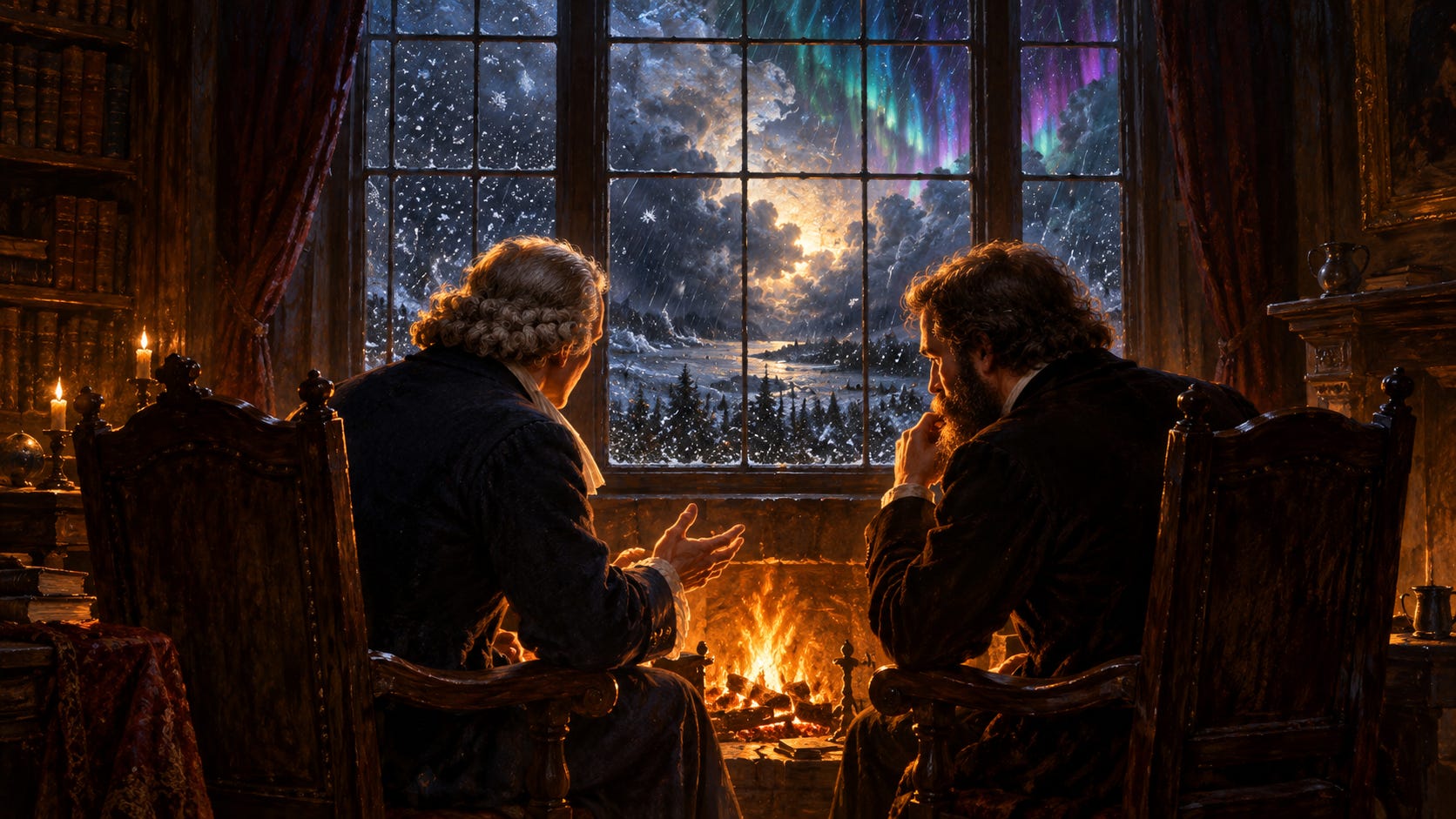
The room is colder than either of them expected it would be, and neither mentions it. A fire is going at one end; the kind built by people who plan to talk until morning and have no firm assurance whether the morning is coming or not. At the other end of the room, a window looks out on weather that has no business existing here. Between the two stand a long table, a lamp, and a pair of chairs set at the angle of an argument somebody has been anticipating for a good while.
Edwards is already in the room, standing at the mantel and meticulously picking scraps of paper off his coat. There are a great many scraps attached. He reads each one in turn with the grave attention of a man auditing his own mind and sets it on a stack that has already begun to lean and quiver. His handwriting is so miniscule that it looks less written than inflicted.
MacDonald comes in shaking the weather off his shoulders, though there probably shouldn’t be any weather as I’ve already observed. He stops in the doorway. “Fit like?” he says.
“I beg your pardon?”
“How are ye. It’s what we say in the north.” He nods at the coat. “You’ll want those off before you get near that fire. They’ll all go up.”
“Sarah usually does it.” Edwards doesn’t look up. “I have not yet had the felicity of locating her, and I find myself obliged, for the first time in thirty years, to undress my own thoughts. Most of these record opinions of which I was entirely certain, a few record opinions of which I was entirely certain and mistaken, and it was among the more instructive discoveries of my later life that the two kinds appear in precisely the same hand.”
“Aye,” MacDonald says, which in his dialect is its own complete theological statement. “How many bairns did you have?”
“Eleven.”
“Eleven.”
They regard each other with the particular silence of two men who spent decades carefully stepping over shoes.
“It was a loud house,” Edwards offers with a brief, affirming nod.
“It was a loud house indeed,” MacDonald agrees. “Mine put on plays. Pilgrim’s Progress, mostly, wi’ a tour.”
“Mine recited the catechism, which I am assured is also a form of theatre.”
MacDonald crosses to the hearth and holds out his palms to its warmth. Neither of them speaks for a while, because it is a particularly good fire. Then, in the same breath, both of them whisper it as if on cue.
“Our God is a consuming fire.”
MacDonald laughs first. Edwards takes a moment longer, like a man double-checking whether laughter is permitted.
“The letter to the Hebrews,” Edwards says.
“Twelve and twenty-nine. I wrote a sermon on it.”
“I built a bit of a reputation on a different verse, I fear.”
“Deuteronomy thirty-two and thirty-five. Their foot shall slide in due time.“ MacDonald nods, enthusiastically. “I’ve read the spider.”
“Everyone starts with the spider.” Something close to a slight grin appears at the corners of Edwards’ otherwise tightly pursed lips.
“You wrote about spiders long before the sermon. I’m told you described their flying as Pleasure and Recreation and then concluded that a Greater end is at last their Destruction.“
“I was young.”
“It’s a very New England sentence, that is.”
Edwards almost smiles again. Almost. “I’ll say this for the sermon. Nobody remembers how it ends. Christ stands calling with a loud voice to poor sinners. It was an invitation, from a man who thought the house was burning.”
“I’d have done the same. I have, in fact. But with fewer spiders.”
Edwards turns from the fire to his companion, in the manner of a man who has decided that a point of courtesy must be settled prior to engaging in business. “I should say, Mr. MacDonald, that I have never regarded you as a stranger. You were bred, as I was, upon the milk of the Reformation; you were ordained, as I was, among the Congregationalists; and I think it a reasonable inference that we hold in common, at the least, that God is sovereign, that man cannot save himself, that the glory of God is the end of all things, and that the Scriptures are to be wrestled with and never lightly dismissed.”
“Aye, I’ll sign the first three, at the least,” MacDonald says. “The fourth I’d word a wee bit different, but we’ll come to it. And ye’re right, Jonathan, I’m family. I think I’m the one nobody mentions at Christmas.”
“I am given to understand,” Edwards says, “that there is a household in Oxford where you are mentioned at some length, and indeed called a master.”
“Is there now.” MacDonald looks pleased and tries to hide it, which in a Scot takes the form of looking severe. “A man named Lewis?”
“So I am told. It seems you baptized his imagination, whatever that may mean. He is not yet here to be asked.”
“Then there’s one table I’m welcome at. I’ll settle for the one.”
“Every house has one. In mine it was the Arminian uncle.”
“Was there an Arminian uncle, truly?”
“There is always an Arminian uncle.”
MacDonald grins. “I’d part wi’ ye on election, mind. I’d keep the choosing. It’s the counting I quarrel with. Ye count some chosen and the rest passed by, and I’d say all are chosen and some are quite slow to open the letter. The shepherd goes after the one sheep until he finds it. That’s Luke fifteen.”
“’Until he find it,’” Edwards says, “is a condition upon the search, Mr. MacDonald, and no report therein of the outcome.”
MacDonald opens his mouth, shuts it, and looks at him with fresh respect. “That’s no a bad answer. I’ll need to think about that one for a time.”
“You have the leisure.”
“Two Congregationalists,” MacDonald says. “A polity wi’ one great virtue. The people may vote out their minister onto the street, and we men were both voted out of it.”
Edwards considers this. “The people exercised their prerogative,” he says, “with enthusiasm.” It was, after all, their strongest inclination in both cases it seems.
He turns back to the fire and says the next thing like a clerk formally reading a deed in an official proceeding. “Then permit me to begin where the quarrel does. There is nothing that keeps wicked men at any one moment out of hell, but the mere pleasure of God.“
Well, isn’t that a fine how do you do. “I’d sign the sentence. And I’d change an adjective.” MacDonald looks into the flames. “You wrote arbitrary will, and then shortly after it, the hand of arbitrary mercy. I’d like to keep the second word if I might be so obliged.”
“Mercy was there all the while.”
“Mercy was there. That’s the word I’d build on.”
“By arbitrary I intended unobliged,” Edwards says. “God owes no man anything. I never suggested without reason. The pleasure of God is the free movement of a goodness that owes nothing to anyone, and I put it so sharply because I wished my hearers to feel that it was mercy, and mercy alone, that held them.”
“Aye, then we’re a bit nearer than either of us was told.”
“Nearer is a measurement. Arrival is a different word altogether.”
“Mind, we’re agreed on where the weight sits. Every ounce on God’s side of the scale, as it ought. No one in this room or outside it ever saved himself.”
“I had hoped that would be the first thing observed.”
MacDonald turns his hands to the heat as if toasting bread on both sides evenly. “This is what I mean, you know. He doesn’t keep it in a drawer for emergencies. The fire is what he is. It burns us until we worship, and then it goes on burning, no longer with pain and consuming, but as the highest consciousness of life, the presence of God.“
Edwards remains still for what seemed like minutes. Then he crosses to the window and stands there with his hands clasped behind him, regarding the improbable weather. “I spent a portion of my youth in the observation of light, Mr. MacDonald, and I have never since been able to look upon a fire without wishing to take its measure. This is an unusually good one, and I find it peculiar that I cannot ascertain its fuel.”
“Aye. That’d be the point of it, I suspect.”
“I once wrote very nearly what you have said. In a treatise almost no one finishes.” He does not turn around. “The knowledge communicated, is the knowledge of God; and the love communicated, is the love of God; and the happiness communicated, is joy in God.“
“That’s the fire,” nods MacDonald.
“That’s emanation and remanation.”
“That’s the fire with a fancy footnote.”
“Mine has better footnotes.”
“Mine has more lamentation.”
MacDonald drops into one of the chairs and stretches his legs toward a hearth that is now a long way off. “I read what ye wrote of the fields. God’s excellency, his wisdom, his purity and love, seemed to appear in everything; in the sun, moon, and stars; in the clouds and blue sky; in the grass, flowers, trees; in the water and all nature. I say, Jonathan. Ye’d have made a fair fantasist in y’er own right.”
“I would have made a poor one. I should have footnoted the dragons.”
“People say I sound like the Greek fathers now,” Edwards says after a pause, still facing the glass. “I never read Palamas.”
“I’m told I sound like Gregory of Nyssa. I’ve not met a Gregory and I’ve not been to Nyssa.”
“Is he here, do you suppose?”
“It’s a large house. I’ve been introduced to a Syrian going by Isaac, mind, who held that the damned are scourged by love. I thought, now there’s a man who could have saved me a good lot of trouble in Arundel.”
Edwards inclines his head, as though a stranger’s name had been mentioned at a dinner he did not particularly wish to attend.
He comes away from the window at last and takes the second chair, at an angle from MacDonald’s. “Here is where we part,” he says, “and it’s the cross more than the fire. Justice requires a payment, and the Son has paid it. I argued the matter at some length, and I have not found the flaw. My premise was that sin being an infinite evil, deserves an infinite punishment.“
“I’d find it in the arithmetic.” MacDonald leans forward. “Ye priced the sin by the dignity of the One it offended. Fair enough. Then price the cure by the dignity of the One who undertakes it. If an infinite offense can ask an infinite penalty, an infinite Love can answer wi’ an infinite mending, and I’d say the second is the likelier sum if I know anything of our Savior.”
“A pretty reversal.”
“I thought so. Here’s the root of it, Jonathan. If punishment were intended as an offset to wrong, then God would be bound to punish. And he cannot be, for he forgives. I believe justice and mercy are one and the same thing. Your sermon needs them to be two.”
“My sermon requires that both be glorified.”
“Aye. That’s the whole difference. Ye ask what the sin is owed. I ask what the sinner needs.”
“Forgiveness costs. Someone pays. There is no escaping that reality.”
“Someone does. He does. I’d only object to the picture where the Father finds in some way satisfaction by punishing the Son.”
“That’s a caricature of my position.”
“Is it, tho?”
Edwards considers this longer than he would like. “A nuanced one, but we shall not dwell on that here.”
MacDonald lets it sit, because he can see the man has had enough of being pressed on it for one evening, and he changes the subject in the direction of agreement rather than away from it.
“I’ll tell ye where I never quarreled wi’ ye at all,” he says. “The Trinity. Ye wrote that the Holy Ghost is the love of the Father and the Son, the very bond between them, God’s own love standing forth as a person. I’d no change a word of that.”
“It is the one place,” Edwards says, “where I am told I was most original and least read. I argued that the Son is the Father’s perfect idea of himself, and the Spirit the love that passes between the two, and that the Godhead therefore subsists in love, before ever a world was made.”
“Aye. And I wrote near the same thing wi’ fewer joints in the sentence. God is Love. Love is the deepest depth, the essence of his nature, at the root of all his being. And that the devotion of the Son to the Father is the bond of the whole universe, so that without Christ there could be no universe at all.”
Edwards turns this over. “Then we both begin in the same place. God is not first power, and love added after. God is love, and the power is love’s truest instrument.”
“That’s the whole of it. And here’s what I canna understand about ye, Jonathan.” MacDonald says it gently, not as a blow. “Ye begin where I begin. A God who is love before the foundation of the world, pouring himself out because it’s his nature to do it, the way a fountain spills over because it’s full. Ye even wrote the fountain. And then ye arrive at a hell that holds some of his creatures in that state forever, and ye equally call that love too. I canna make the river run uphill at the end.”
“Because the love is holy,” Edwards says, “and holiness is not indifferent to what it loves. The fire that warms is the fire that burns. It is the same fire.”
MacDonald looks at him for a moment, and something passes over his face that is almost triumph, except that he is too fond of the man to let it show. “The same fire,” he says. “Now ye’ve said my sermon for me. I’ll just put my feet up.”
“I have said but half of it.”
“Ye have. I only follow the fire a bit further than ye will, and watch what it does when there’s nothing left to burn.”
The lamp gutters and steadies. Neither of them moves to tend it. Outside, the weather has changed again, into something that might be dawn or might only be the fire reflected in the glass.
“You spoke of beauty,” Edwards says, unexpectedly, as a man returns to a thing he had set down. “When you were young. Was it beauty that first made you doubt the God you were given?”
“It was.” MacDonald does not pretend to misunderstand. “I was given a God who had chosen a few and could thole the rest, and I looked at the hills above Huntly, and I thought, the man who made that does not at all do his sums the way they tell me. What made ye doubt yours?”
“I never doubted mine,” Edwards says. “That was the difficulty.” He says it without self-pity, as a plain finding. “I saw the same beauty you saw. I wrote that the excellency of God appeared to me in the grass and the clouds and the water and all nature, and I meant every word, and I never once let it argue with the system. You let yours argue. I have been considering, this past hour, whether that was the greater courage or the greater disorder.”
“And yer conclusion?”
“I have not reached a finding.”
“Then ye’ve the whole of eternity to reach one, and a Scot to pester ye the length of it, to boot.”
“Yes, I had feared as much.”
This is the first of a two-part series. The dialogue is imagined; the words in italics are direct quotes. Please see full sources for this series at the end of Part Two. Thanks for reading.
Thank you… as a fan of Edward’s love of beauty, and MacDonald’s love of God’s love, I found this essay to be a remarkable weaving!
"I canna make the river run uphill at the end.”
You've a fine and engaging hand at writing, and narrative here, brother Connelly. I'll be finding a use for that turn of phrase within the next three weeks at the retreat of the Episcopal Diocese if Iowa's Directors*, somewhere, I'm pretty sure. The Bishop's turn of phrase for the coming year rotates around an image of a well-tended Iowa cornfield in summer, directly adjacent to wild prairie meadow across the fenceline. The model of Machine-tilled (and Machine-serving) field is monoculture, exhausted, and stands in for the large worship spaces that are no longer affordable by the folks remaining, even if you doubled them. And yes, I have studied this at the community level. The meadow, on the other hand, has roots that go deep, and an environment that is far more self-sustaining.
There will be serious push-back from folks who feel entitled to continue to 'have it their way', and I'm already seeing that; and,
Your conversation, both yours, and your imagined fireside one, provide insight, and a phrase ("I canna make...") that could stop some yammering, and open to some listening. So, thank you. Also, fortunately, assuming trans-Atlantic aviation continues into November, I'll have had the privilege of being in the same room in nearby Madison, Wis, as anglo-irish writer Paul Kingsnorth ("Against the Machine: On the Unmaking of Humanity") the week before, so I'll be gently (Karen* hopes...) primed to, as fictitious Irish bartender Mr. Dooley put it, to: "Comfort the afflicted, and afflict the comfortable".
Thanks, as always, for your work here.
Tim Long, Just Up the Hill from Lock 15.
*She's the stalwart servant of our sinking ship and church who also makes me cinnamon raisin toast and coffee in the morning...
Your piece here gets another reading this evening.