


Essay Four - Limited Atonement
I used to preach this one. Not particularly softly, either.
The argument went kind of like this. An atonement that merely makes salvation possible accomplishes nothing in actuality. If Christ died for every person who ever lived, and some of those people are not ultimately saved, then his death failed in the case of every one of them, and a failed sacrifice is an awfully odd thing to sing about on a Sunday morning. So the choice is really between potential atonement and actual atonement. The claim is that Christ did not die just to make salvation possible for all. He died to make salvation certain and secure for the ones the Father gave him. You see, the cross actually accomplished something, actually everything it was intended to accomplish, and what it accomplished was not just a hypothetical or contingency.
I have been, at times, inclined to say I have abandoned this argument as I’ve moved further from my traditional Reformed roots. I haven’t though. I still think it is pretty close to airtight, and the version of it I used to posit is still the strongest objection anyone has to the standard Arminian position that is pervasive outside of Reformed spaces. The cross either really did something or it only stood ready to do something pending human cooperation, and those are genuinely different claims about what happened on that fateful Friday.
What changed for me isn’t so much my view of what the atonement accomplishes. That is rather clear. I still believe it achieved precisely what it was intended to achieve. What changed rather significantly is my view of where it stops.
To explain that, let’s start where this series typically starts, with what Dort actually says about the issue, not just what the famous acronym implies it said.
The second head of doctrine opens by affirming that the death of the Son of God is the only and most perfect sacrifice for sin, of infinite worth and value, and abundantly sufficient to expiate the sins of the whole world.1 That sentence is in the canons. It is also in the same document that the L in the acronym is meant to summarize. Anyone raised on the notion of limited atonement as the doctrine that Christ died only for the elect should read Article 3 twice and then ask why nobody talks much about it.
A Reformed reader already has the answer to that, of course, and it is a substantial one so let me put it the way they would. Article 3 is a statement about value, not about scope. The sacrifice carries infinite worth because of the dignity and status of the person who offered it, and infinite worth is not the same thing as universal intent. God could have saved every person who ever lived with Christ’s death. He purposefully designed it to save only the elect. Price and power on one side of the ledger, and purpose on the other. The doctrine is often alternatively called particular redemption for exactly this reason, and that is indeed the better name for it, since it locates the limitation where the tradition actually puts it, which is in the intention rather than in the worth.
That reading is largely coherent and it is held by serious, scholarly people. It is also not the only reading the canons permit, though I thought for decades it was.
The limitation language shows up five articles later. Article 8 says that God willed Christ, by the blood of the cross, to effectually redeem all those and only those who were chosen to salvation and given to him by the Father.2 There it is. It’s on the page, and I am not going to soft-pedal it.
But look at what the two articles do when assessed together. Article 3 speaks of sufficiency and Article 8 speaks of efficacy, and those aren’t the same. That distinction did not originate at Dort either. It goes back at least to Peter Lombard in the twelfth century, whose formula held that Christ died sufficiently for all and efficaciously for the elect.3 The synod inherited a piece of standard medieval furniture and set it in the middle of the doctrinal room without much comment. Four hundred years of Reformed teaching have people believing the second half of Lombard’s sentence and acting like the first half were some kind of Arminian Trojan horse.
And the real argument the tradition has actually been having for four centuries is about what kind of sufficiency Article 3 asserts. If it means only that the sacrifice possessed enough intrinsic value to have covered everyone, the article is nearly empty, because that would remain true if God had elected a hundred people, or just one, or none at all. The alternative is that the sufficiency is ordained rather than bare, meaning God appointed the death of his Son as a remedy genuinely applicable to every person, and grounded a real conditional promise on that appointment.
Dort supplies material for the second reading two articles later. Article 5 says the promise of the gospel, that whoever believes in Christ crucified shall not perish but have eternal life, together with the command to repent and believe, ought to be announced and declared without differentiation or discrimination to all nations and people. Article 6 goes even further and says that those who hear and perish in unbelief do so not because the sacrifice of Christ is deficient or insufficient, but because they themselves are at fault.4
Read that last line again. In the document the L is named after, the reason a person perishes is explicitly not that Christ’s death lacked something for him.
The history from here is contested, so I will lay it out and then let the other side answer.
The British delegation to Dort included John Davenant, Lady Margaret Professor of Divinity at Cambridge and later bishop of Salisbury, and Samuel Ward, master of Sidney Sussex. Both men held a position later scholarship calls hypothetical universalism. The label is modern and somewhat unfortunate, since nothing about it was actually hypothetical to the men holding it. Davenant’s position ran roughly this way. God appointed the death of Christ as a remedy sufficient for and applicable to every human being, and established on that appointment a genuine conditional covenant, that whoever believes shall be saved. The offer is not a bluff, because the remedy really is there for anyone who comes to it. Alongside that general intention, God also held a special and absolute intention to give faith to the elect, so that the remedy would certainly be applied in their case. Two intentions, one death. Christ died for all by divine appointment and for the elect by divine determination.
I’ll be honest that this has always struck me as fine print. The general intention does nothing whatsoever for anyone the special intention does not already cover, which makes it look like a remedy stocked on a shelf that nobody without a key can reach. Davenant’s defenders would answer that this is exactly what an honest offer requires, that a conditional promise has to be grounded in something real or else the preacher making it is lying. That answer has genuine force and I don’t dismiss it. But hold the thought, because the position I am going to land on needs only one intention to work.
Both men signed the canons. They did not sign under duress or with crossed fingers, so far as anyone can tell. Michael Lynch’s recent study of Davenant argues that the British delegates shaped the final form of the canons precisely so that their position would fit inside them, that drafts were reworked over British objections, and that Davenant exercised major influence on the language the synod finally adopted.5

Two of the men in the room believed Christ died for everyone in a real sense, and the document they helped write is the document later generations cite to prove he did not.
The counterargument to this deserves a legitimate hearing. R. Scott Clark and other Reformed historians contend that the case for hypothetical universalism’s confessional standing is circumstantial, built on what Dort declined to condemn rather than on anything it affirmed, and that a synod’s failure to challenge a view is weak evidence that it endorsed one.6 That’s fair. Silence, after all, is not approval. What survives the objection is narrower and still substantial, which is that the canons were drafted with enough room for men holding a broader view to sign them in good conscience, and that the flat popular version of the L does not describe the true intent or parameters of the document.
Which loops us back to where this series of essays started. The acronym is a memory aid built in 1905, and of the five letters, the L may be the one that distorts its original source the worst. Dort says sufficient for the whole world while the mnemonic says limited. Both cannot be doing the same job or meaning the same thing.
Now to the Scriptures, because both sides have their favored proof texts.
The particularist case runs through John 10, where Jesus lays down his life for the sheep, and Ephesians 5, where Christ gives himself up for the church. Acts 20 has Paul telling the Ephesian elders to shepherd the church God obtained with his own blood. Matthew has the Son of Man giving his life as a ransom for many. These passages specify a group, and the specificity isn’t accidental.
Someone inevitably asks about the Greek, so let me deal with it honestly. For the sheep and the church there is nothing here to find. Probata means sheep and ekklēsia means assembly, and no lexicon is going to rescue anyone from the plain sense of either. The counterargument in those cases is logical rather than lexical, and I will get to it in a moment.
“Many” is a different matter, however. Matthew and Mark both have the Son of Man giving his life as a ransom for many, and English hears an implied contrast there, many as opposed to all. The underlying idiom does not necessarily carry that meaning. The phrase reaches back to the fourth servant song in Isaiah, where the servant bears the sin of the rabbim, a Hebrew term for the multitude or the great mass, and the Greek polloi follows the Hebrew. In that idiom the many are not the few. The many are everybody, seen as a crowd rather than counted one at a time.7
That is one of the hazards of building doctrine on English, or on the Latin before it. We hear our own idioms inside the text and mistake them for the text itself. The plain reading of Scripture is rarely plain once accuracy enters the picture.
The universal texts are just as straightforward. First John says Christ is the propitiation for our sins and not for ours only but for the sins of the whole world. First Timothy says he gave himself a ransom for all. Second Corinthians says God was in Christ reconciling the world to himself. John the Baptist points at Jesus and calls him the one who takes away the sin of the world. Hebrews says he tasted death for everyone. First Timothy calls God the savior of all people, especially of those who believe.
The Greek has quite a bit more impact on this side. The standard Reformed handling is that kosmos means the elect drawn from every nation rather than every individual, and that pas means all kinds rather than all persons. In some cases that reading is correct, and context does occasionally demand it. But watch what it does to First John, where the sentence sets the world against “ours” inside a single clause. On the restrictive reading, John wrote that Christ is the propitiation for our sins and not for ours only but also for the sins of the elect, which is not a sentence anyone has ever written, at least on purpose.8
First Timothy 2 is the better ground for the other side and I will readily admit that. The context there is prayer offered for kings and all who are in high positions, so “all people” in that passage plausibly does mean people of every station. We can concede it and move on.
First Timothy 4:10 is the one I keep returning to, though. God is the savior of all people, malista of those who believe. The usual rendering is “especially,” which leaves a strange two-tier arrangement in which God saves everybody and then saves believers more somehow. Some scholars argue malista here functions to specify rather than to intensify, meaning something closer to “that is to say.”9 Either way, the verse survived the entire process of canonization and copying without anyone smoothing it out, which is the thing I find hardest to explain if the early church understood the atonement as strictly particular.
What the restrictive reading cannot endure is being applied everywhere the word appears, because at that point it has become a rule for producing a predetermined result. This is a very common occurrence in the Reformed reading of things, I fear.
And the particularist texts cited above actually prove less than they’re given credit for when adequately scrutinized. Christ died for the sheep. He also died for the church. Both statements are true on any account of the atonement’s extent, and neither one excludes anybody unless the passage says so. If a man tells his wife he would die for her, he has not thereby announced that he would let the neighbors drown. Specifying one object of love is not a de facto denial of every other.
So here is a grid I wish somebody had drawn for me at nineteen.
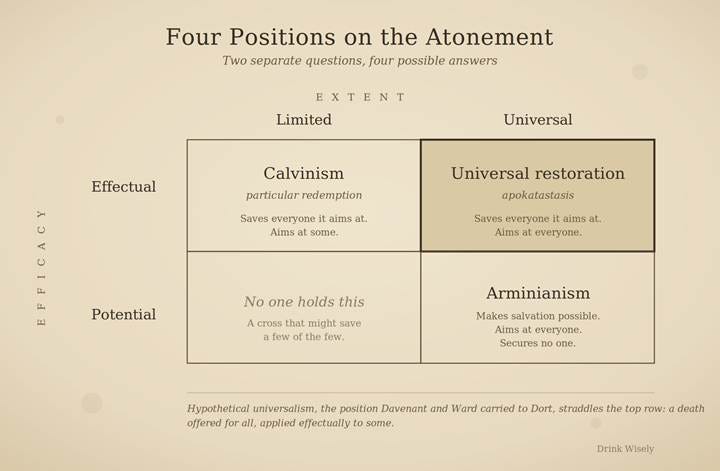
Two questions are in play here, and they need to be kept separate. Is the atonement actual or merely potential, and is its extent limited or universal? That gives four possible positions, and the tradition I was trained in only ever showed me three of them.
The Calvinist takes effectual and limited. The Arminian takes potential and universal. The hypothetical universalist straddles the top row and gets accused by both sides of waffling or outright denying an obvious truth.
The fourth position is where things get quite interesting for us. This one claims Christ’s atoning death on the cross is both effectual and universal. An atonement that actually accomplishes what it sets out to accomplish, all of it, and it doesn’t cease at a certain subset. Note also what it doesn’t require. No second intention, no general provision running alongside a special one, no fine print. One intention, perfectly carried out.
I truly never really considered it. Not once in my entire adult life until rather recently. The system I was formed in didn’t present it as a wrong answer to be refuted. It simply did not exist as a consideration. That is a different kind of formation than being taught something false. A wrong answer can be reexamined later, when you’re older and braver and have read more. An answer that was never on the board doesn’t come up for review at all.
On extent, I have come to hold a position the tradition calls universalism. I was an infernalist (to borrow a favorite David Bentley Hart phrase) my entire life. I taught it, I defended it, and I want to be completely forthright that it never once rested easy with me and what I knew otherwise of God’s character. I am not going to argue for that entire position here, because doing it properly requires more room than an essay in a series about the five points can give it, and because this essay is more narrowly about what Dort said and whether the L accurately describes it. But it would be dishonest to write a piece asking who the atonement was for while concealing my own answer to that question.
For anyone about to reach for their doctrine police badge, the company I now keep is older and considerably broader than most Protestants know.
Begin with a hostile witness. Augustine, who did more than any other single figure to fix eternal punishment in the Western imagination, complains in the Enchiridion that some, indeed very many, recoil from the notion of endless torment and simply do not believe it will happen. He is careful to add that these people are not setting themselves against Scripture. They read the same texts he reads and hear something different in them. Whatever else that tells us, it tells us the position was common enough in fifth-century North Africa that the most influential theologian in Latin Christianity had to argue against it at length.10
The ancient roster runs long and deep. Clement of Alexandria. Origen, who is the complicated case and I will come back to him. Macrina, who makes the argument in her brother’s own dialogue. Gregory of Nyssa himself, not some marginal ascetic but a Cappadocian bishop whose fingerprints are on the creed most of us still recite. Diodore of Tarsus and Theodore of Mopsuestia in the Antiochene school. Isaac of Nineveh in the seventh century, whose second volume was only rediscovered in 1983 and is about as explicit as a text can get, insisting that God never repays evil with evil and that what we have come to call hell belongs finally to mercy. In the ninth century, Eriugena. In the fourteenth, Julian of Norwich, who feels the tension honestly and declines to resolve it against the God she actually knew.11
Ilaria Ramelli has documented the breadth of that stream from the New Testament through Eriugena in a volume running nearly a thousand pages. Her work is contested, and Michael McClymond in particular has pressed hard on her methods and some of her attributions, so I cite her as documentation of a real and widespread current rather than as an undisputed verdict.
Then the objection everybody raises, which is that the church settled all this at Constantinople in 553. That one needs some care. An explicit anathema against universal restoration does exist, but it belongs to an edict Justinian issued in 543 and to the local synod that ratified it. Whether the ecumenical council of 553 formally promulgated the fifteen anathemas against Origen has been questioned by historians for more than a century, and Richard Price’s edition of the council’s acts makes the case that they were approved by bishops assembled before the council formally opened rather than issued by the council itself. That reading is disputed, and sometimes with real heat. What nobody disputes, though, is that the same council commended the orthodoxy of Gregory of Nyssa, who taught universal restoration in very plain words.12
The modern list of adherents to universalism is not short either. George MacDonald, who never persuaded C. S. Lewis on this point yet shaped his imagination permanently anyway. F. D. Maurice, who lost his chair at King’s College London in 1853 for denying eternal punishment. Sergius Bulgakov and Hilarion Alfeyev in the Russian tradition. Jürgen Moltmann. Thomas Talbott, arguing as an analytic philosopher. Robin Parry. And two figures worth naming separately because they mark the outer edge of what the institutional churches permit, Hans Urs von Balthasar and Kallistos Ware, neither of whom asserted universal salvation as settled doctrine but both of whom insisted that Christians are permitted, even obliged, to hope for it.13
The infernalist reading has undoubtedly been the dominant one in the West for most of Christian history, and anyone who tells you otherwise is selling something. What I have listed is admittedly a minority stream. What it is not is a fringe, a novelty, or a modern accommodation to soft feelings, which is how it usually gets characterized. It runs continuously from the second century to this morning, and it includes canonized saints, one of the men who gave us the Nicene Creed, and theologians the institutional churches have never quite been willing to condemn.
Hart made the contemporary case most forcefully a few years ago in That All Shall Be Saved, and while his tone toward opponents and flowery prose are exceedingly entertaining, his argument is serious and rigorous and has not been answered sufficiently so far as I am aware.14
But what I want from this particular essay is smaller than all of that.
The doctrine of limited atonement really exists to protect something legitimately worth protecting even while it gets some of it wrong. Its defenders are right that a cross which merely makes salvation available or possible has been demoted to an offer, and that an offer cannot be confused with a rescue. I made essentially that argument for years and years, and I would still make it.
The mistake, my mistake, was in the conclusion drawn from the argument. Faced with the choice between an atonement that saves everyone it aims at and an atonement that aims at everyone, the tradition assumed it had to give up one, and it gave up the wrong one. It kept efficacy and surrendered scope. The older tradition, the one running through Nyssa and the Greek fathers that never quite got extinguished, rightly kept both.
Every argument I ever made for the L was actually an argument specifically for efficacy. Not one of them was an argument for limitation. The limitation came built in by default with the theological system, riding along as if it were part of the same claim, and I never bothered to question or consider separating them because nobody in my carefully curated sphere of influence ever really had.
That is precisely the point of the fourth box nobody ever drew. Irresistible grace is next, and it asks what happens when the God who wants everyone gets what he wants.
Endnotes
1 Canons of Dort, Second Main Point of Doctrine, Article 3.
2 Canons of Dort, Second Main Point, Article 8.
3 Peter Lombard, Sentences, Book III. The formula that Christ died sufficiently for all and efficaciously for the elect became standard scholastic shorthand well before the Reformation and was the background against which Lutheran, Remonstrant, and Reformed positions all defined themselves.
4 Canons of Dort, Second Main Point, Articles 5 and 6.
5 Michael J. Lynch, John Davenant’s Hypothetical Universalism: A Defense of Catholic and Reformed Orthodoxy (Oxford University Press, 2021). Lynch’s study is the first to examine in detail how the British delegates shaped the final form of the canons. John Davenant (1571-1641) was Lady Margaret Professor of Divinity at Cambridge, a delegate appointed by James I, and later bishop of Salisbury; his De Morte Christi was published posthumously in 1650. Samuel Ward (1572-1643) was master of Sidney Sussex College. The full British delegation also included George Carleton, Joseph Hall, who fell ill and was replaced by Thomas Goad, and Walter Balcanquhall representing Scotland.
6 R. Scott Clark and other Reformed historians have argued that the case for hypothetical universalism’s place within confessional orthodoxy is circumstantial and rests substantially on what ecclesiastical bodies did not do.
7 Matthew 20:28; Mark 10:45; Isaiah 53:11-12. The inclusive reading of Hebrew rabbim and Greek polloi in the servant song is associated especially with Joachim Jeremias and is widely followed, though not unanimously.
8 1 John 2:2. The clause sets hēmeterōn against holou tou kosmou within a single sentence, which is what makes the restrictive reading awkward here specifically.
9 1 Timothy 4:10. The specifying sense of malista has been argued in the scholarly literature and remains contested.
10 Augustine, Enchiridion 112. The phrase rendered “some, indeed very many” is immo quam plurimi. Augustine notes that those who hold this view do not set themselves against Scripture but read its harsher statements as intended to terrify rather than to describe literally. He returns to the same opponents in City of God 21.17, where he calls them the merciful ones.
11 Clement of Alexandria; Origen; Macrina, whose argument Gregory of Nyssa records in On the Soul and the Resurrection; Gregory of Nyssa, especially in the Catechetical Oration and his treatise on 1 Corinthians 15:28; Diodore of Tarsus; Theodore of Mopsuestia; Isaac of Nineveh, whose second part was rediscovered in an Oxford manuscript in 1983 and published in 1995; John Scotus Eriugena; Julian of Norwich, Revelations of Divine Love.
12 Richard Price, The Acts of the Council of Constantinople of 553, 2 vols. (Liverpool University Press, 2009). The nine anathemas explicitly condemning universal restoration belong to Justinian’s edict of 543 and the local synod of 544. Whether the fifteen anathemas against Origen were formally promulgated by the ecumenical council of 553 has been disputed since Diekamp raised the question in 1899.
13 George MacDonald, Unspoken Sermons; F. D. Maurice, Theological Essays (1853), publication of which cost him his professorship at King’s College London; Sergius Bulgakov; Hilarion Alfeyev, who has written extensively on Isaac of Nineveh; Jürgen Moltmann, The Coming of God; Thomas Talbott, The Inescapable Love of God; Robin Parry, writing as Gregory MacDonald, The Evangelical Universalist; Hans Urs von Balthasar, Dare We Hope “That All Men Be Saved?”; Kallistos Ware, “Dare We Hope for the Salvation of All?”
14 David Bentley Hart, That All Shall Be Saved: Heaven, Hell, and Universal Salvation (Yale University Press, 2019). Ilaria L. E. Ramelli, The Christian Doctrine of Apokatastasis: A Critical Assessment from the New Testament to Eriugena (Leiden: Brill, 2013), and her two-volume A Larger Hope? (Cascade, 2019); for the critical response see Michael McClymond’s review essay.
15 Scripture references in this essay: Isaiah 53:11-12; Matthew 20:28; Mark 10:45; John 1:29; John 10:11, 15; Acts 20:28; 2 Corinthians 5:19; Ephesians 5:25; 1 Timothy 2:1-6; 1 Timothy 4:10; Hebrews 2:9; 1 John 2:2. Scripture is paraphrased throughout rather than quoted.
I'm a retired Lutheran pastor, and I am really enjoying this, Thank you. (Lutherans, as you possibly know, are quite close to Calvinists in some ways, but they tweak things differently and start in different places.) We take the efficacy argument very seriously. One guy in my church who was married to a Lutheran but was actually Reformed himself once said that Jesus only died for the elect because "He wouldn't waste his blood", which is a different argument than I had heard, and, I think, a bad one.
Such interesting and carefully thought out writing. I already disagree with a universalist position and can offer scriptural reasons; I suspect you've already got answers for those. I will read on expecting more clarification on your conclusions. Thank you!