


“You will know the truth, and the truth will set you free.” — John 8:32
Inside the Cave
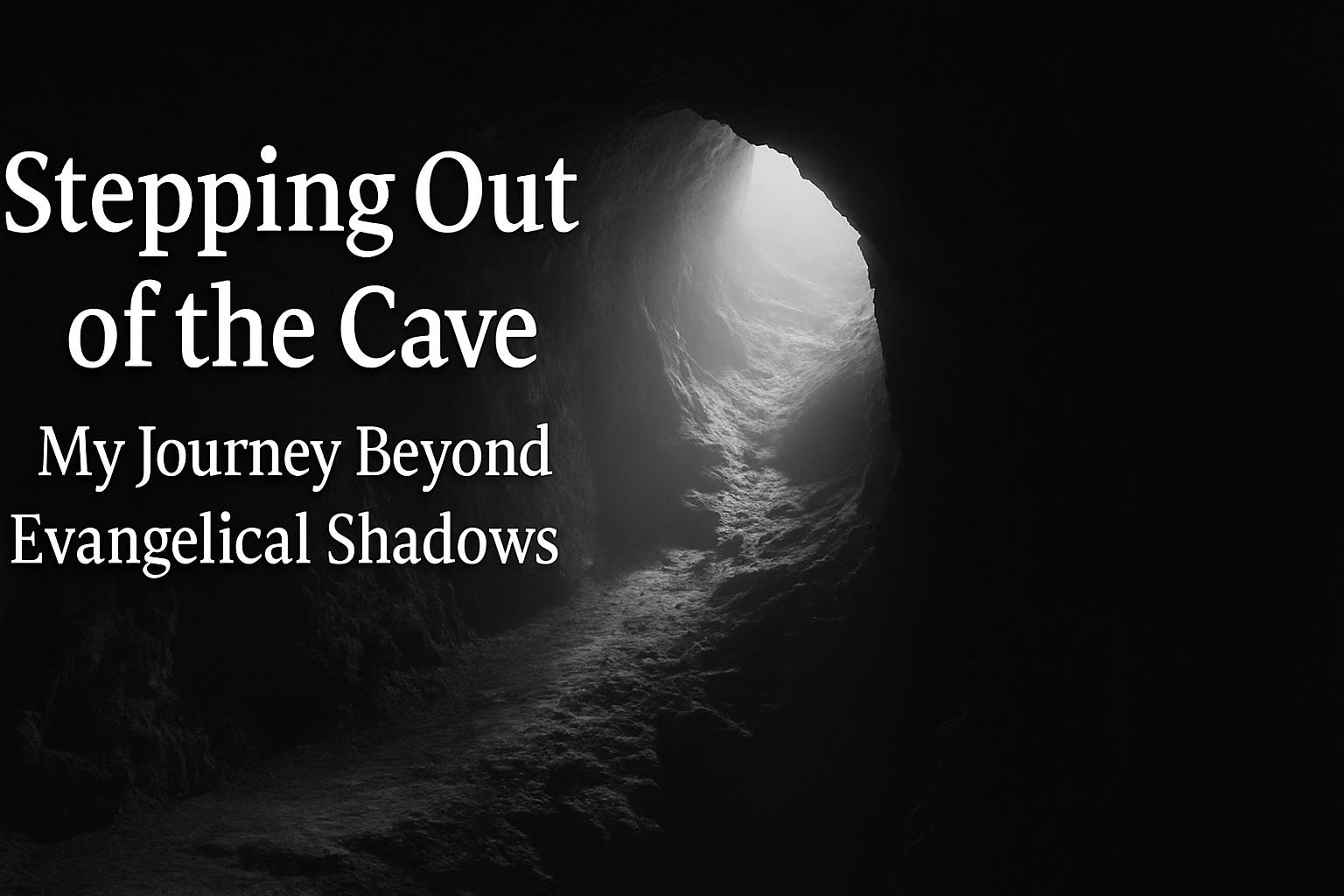
For much of my life, I lived in what Plato described as the cave. In his allegory, people are chained and forced to stare at shadows flickering on a wall. The shadows are all they know, so they mistake them for the fullness of reality. Truth, for them, is little more than what has been projected for their consumption.
That ancient picture still feels uncomfortably familiar.
I grew up Catholic through grade school, then moved into various Protestant denominations from junior high onward. For decades, I was deeply immersed in evangelical life — ordained as a minister early on, later serving in teaching and leadership roles, and eventually serving as a ruling elder in several congregations for well over twenty years. In every sense, I was committed.
The church wasn’t just a community. It was the lens through which I understood reality itself — a curated reality, though I wouldn’t have used that word for it then.
I was told I was seeing the light. But I was staring at shadows: comforting projections that kept the tribe assured of its own righteousness and right standing with God. Inside the cave, those shadows simplify everything into binaries — us versus them, good versus evil, God’s people versus God’s enemies, left versus right. It’s a world perfectly suited for fear, and for fomenting culture wars.
That kind of safety is deceptive. It blurs truth with ideology. It substitutes certainty for humility, fear for love, political loyalty for genuine discipleship. And when you’ve lived long in the dark, the shadows become familiar, and familiarity has a way of passing for truth.
Turning Toward the Light
Over time, I began to turn my head. My studies, my conversations, and my exposure to broader streams of Christian thought — Catholic, Orthodox, mainline, global — opened me to perspectives I had never been encouraged to consider. In fact, they were often actively discouraged. History, philosophy, and voices outside the evangelical ecosystem revealed a larger and more complicated reality than the one I had taken for granted as complete.
Walking toward the light meant questioning beliefs I had once defended fiercely, and realizing that some of them were never really about God at all. They were about control.
“The opposite of faith is not doubt, but certainty.” — Anne Lamott
The deeper I looked, the more I saw how much of my world had been carefully constructed around the same assumptions — an ecosystem of books, sermons, and conversations all orbiting each other, a bubble of belonging that felt complete only because it was sealed. When you live long enough in a closed system, you stop noticing the walls. The air inside starts to feel normal, even holy, until you step outside and realize how thin it’s been.
Stepping outside that world was disorienting at first. Competing truths, conflicting voices, unanswered questions — it felt like chaos. But slowly, the chaos began to sound like freedom.
For years, I thought faith was about holding the right map, one with all the landmarks clearly labeled and every route guaranteed to lead home. Now I think it’s more about having the courage to admit that the map you were given has mistakes. Some roads dead-end. Some mountains aren’t where they were drawn. And every so often, the compass spins for reasons you can’t explain. Maybe faith isn’t about tossing the map. Maybe it’s learning to keep walking after you’ve realized the cartographers weren’t infallible.
Beyond the Shadows
Evangelicalism often warns that stepping outside its walls is dangerous, even heretical. What I’ve found is that staying inside too long carries its own dangers. It can blind you to the wider horizon that faith was always meant to include.
Still, the cave itself isn’t all bad. The people there aren’t deceivers — they’re devoted. The shadows on the wall aren’t deliberate lies; they’re just the limits of the light available at the time. Every tradition sees by the light it has, and every generation has to decide whether that light is still enough to see by.
“Faith in God is not about certainty; it’s about trust in the midst of uncertainty.” — Peter Enns, The Sin of Certainty
The light beyond the cave doesn’t destroy what came before. It reveals it. It shows where inherited certainties were partial, where our language about God was too small, where the tradition we received was doing more work than it could bear. And it invites us to hold what we’ve learned more honestly, knowing that truth is always larger than our current grasp of it.
I can still see where I came from. I’m just standing somewhere else now. That’s not arrogance. It’s geography.
Stepping out of the cave isn’t a rejection of faith. It’s a recalibration of it. What I thought was the edge of the map turned out to be the edge of someone else’s certainty. The territory keeps going.
* * *
Note: The Richard Rohr quote attributed to Falling Upward in earlier versions of this piece has been updated pending source verification. The Anne Lamott attribution above is widely documented. The Enns attribution is from The Sin of Certainty (2016).
💡 Next reflection: The Certainty Trap →
Tags: Faith, Philosophy, Theology, Deconstruction, Evangelicalism, Culture, Spiritual Growth