


Probably fifteen years before I left church leadership, I sat through a discussion defending Genesis 1 against an attendee who had read some scholarship and wanted to know why day three of creation grows plants that day six’s man won’t exist to eat yet. I had an answer. Genesis 2 isn’t a second, different creation account, I said, it’s a close-up on day six, depicting the same events through a different lens. That answer sounds airtight until you say it out loud to someone who already knows the text and watch their face change, because you’ve just explained away the obvious reading instead of reading what’s actually on the page.
What stopped working for me that night and many since was the apparatus it took to keep reading the text like a historical transcript, not my trust in the text itself.
This essay argues that the Hebrew Scriptures were written in genres that tell the truth the way a story tells truth, by shaping a people’s identity and naming what’s real, not by filing an accurate historical report. Myth, saga, parable, liturgy, wisdom dialogue. Reading those genres as modern history empties them, trading their theology and their craft for a grade on accuracy no one asked these genres to earn. Reading them as myth and allegory gives that back.
One line has to go in now, before the examples, because without it the argument gets heard incorrectly from the first page. A text can abandon modern historiography while still claiming that God acted in real history, and it can set even that specific claim aside without becoming empty fiction. This is a claim about genre, about what these authors were doing when they wrote, not a verdict on whether anything in the text is real. Keep that distinction in view.
The Order Problem
Genesis 1 puts land animals in place before humans, then makes humanity male and female in a single verse, at the close of a six-day sequence, as the sequence’s crowning act (Gen. 1:24-27). Genesis 2 opens with its own formula, “these are the generations,” forms a man first out of dust (Gen. 2:7), plants a garden around him, brings him animals one at a time to see if any of them will serve as a companion (Gen. 2:18-20), and only after that fails forms a woman from his side (Gen. 2:21-22). Two different accounts give two different orders, using different names for God, different Hebrew styles, and different pictures of how the world was made.
Reconciling the two into a single sequence requires a lot of creativity. Day six has to stretch long enough for Adam to name every creature in the garden before Eve shows up. Genesis 1 would have to summarize the events in one order, and Genesis 2 would have to narrate the same events in a different order, flatly contradicting the summary. That’s substantial effort, imposed from outside, to keep two timelines in alignment that were never intended to match up.
The same pressure shows up anywhere the text gets specific. The genealogies in Genesis 5 and 11 don’t add up to the same total age of the earth depending on which manuscript tradition you follow, and a long apologetic tradition has spent two centuries inventing gaps in the lists to make room for geology. Reign lengths and troop counts in Kings and Chronicles disagree in ways no copyist error explains well. Every one of these is survivable on its own. Together, they describe a pattern: a text that keeps needing outside help to read the way literalism needs or wants it to read.
None of this is meant to be a case against the people who hold that line. Most Christians defending inerrancy are doing it out of devotion to a book they take to be God’s own speech, and that’s not a small thing to risk. But devotion to the text and defense of a particular reading strategy for it are actually two separate commitments, and the second one keeps failing the first. Literalism doesn’t protect Scripture’s authority so much as spend it, one harmonization at a time, propping up a reading the text was never intended to convey.
Four Terms, Defined Once
Four words essentially drive this entire essay, and if they are allowed to remain vague, definitionally, the whole argument is lost.
The word myth, in the sense biblical scholars use it, is not a synonym for falsehood or “made up.” Folklorists going back to William Bascom classify myth as a traditional story, set in a primeval age, that explains how the world and a community’s place in it came to be the way they are.1 A myth’s job is to order reality and anchor identity, not to report what a camera would have caught. Calling Genesis mythic in this sense is a claim about its genre and its purpose, not an attack on its truth claims. Evangelical and fundamentalist readers get this backward constantly, hearing myth as a synonym for lie and reacting accordingly.
Allegory is narrower. An allegorical story maps its elements onto something else on a nearly one-to-one basis: Adam stands for humanity, the garden for communion with God, exile for the human condition outside it. Strict allegory is one non-literal mode among several, which is not interchangeable with myth, and not every symbolic text works in this way. David Galston has recently made a useful point about Jesus’s own parables. A parable is a metaphor rather than an allegory, and no parable in the Synoptic tradition includes God as a character.2 Read the father in the Prodigal Son or the master in the Unjust Steward as standing directly in for God, and you’ve imported a theological claim the parable’s own form doesn’t make. The warning travels backward into the Hebrew Bible too. Not every symbol-heavy story is doing allegory’s one-to-one work, and forcing that interpretation onto a text can manufacture a cleaner meaning than the text actually suggests.
Karl Barth supplied a third term: saga, a narrative set in the prehistory before ordinary historical reportage becomes possible, theologically true without being historiography.3 Barth read Genesis 1-11 this way without treating it as fiction or as journalism. It occupies its own category, one literalism doesn’t have room for, because literalism only recognizes two settings, fact and fabrication.
The fourth term covers the ground the others don’t. Call it theological history, or what Jan Assmann calls cultural memory: the story a people tells about its own past to define who it is now.4 A nation’s founding memory, Assmann argues, gets retold and reshaped across generations to carry identity forward, and the truth claim embedded in it concerns that identity and God’s involvement in it, not a match against an archive. Genesis and Exodus both work this way, and asking them to behave like court transcripts misreads the kind of document each one is.
One distinction holds these four terms together. Genre and truth sit on different axes. A text can leave modern historiography behind without leaving behind the claim that God acted in history, and it can leave even that claim open without becoming fiction. Myth, allegory, saga, and cultural memory are all claims about what a text is doing and how it means. None of them settle, on their own, whether an event behind the text occurred. Bart Ehrman draws that same line by asking two different questions about a single story: whether it’s true, and whether it happened. The answers don’t have to match.

Five Texts, Read Straight
Theory is cheap until it meets an actual text. Here are five, read on their own terms.
Creation, Read As It’s Written
Start with the signal the text drops before any theory gets applied to it. Light exists on day one. The sun, moon, and stars don’t show up until day four (Gen. 1:3, 14-19). A text reporting literal chronological history doesn’t stage photosynthesis three days before a light source capable of producing it. A text building a seven-day liturgical structure, with day four slotting the great lights into their assigned place in an already-ordered cosmos, does exactly this, and does it on purpose. The cosmology throughout is ancient Near Eastern: a solid dome (firmament) holding back waters above the sky, waters below the earth, a flat disk between them (Gen. 1:6-8). That isn’t a mistake needing apologetic explanation. It’s the architecture everyone in the ancient Near East used to describe the world back then, and Genesis is working inside it. Add to that a habit modern readers bring to the text without noticing: treating the Hebrew Bible as though it were written directly to them, rather than to an ancient Israelite audience with its own questions and its own cosmology.
The parallels to Enuma Elish and other regional creation accounts aren’t an embarrassment to manage either. They’re the point. Genesis draws on the same ancient stories its neighbors told and argues something different with them: one God instead of a warring pantheon, creation by unopposed speech instead of violent combat between gods, humanity made in the divine image instead of conscripted as slave labor to feed the gods their due. Read against its ancient counterparts, Genesis 1 reads as a theological argument against its neighbors’ gods, not a science report, written in the only cosmological vocabulary its original readers had.
John Walton has made the case that the seven days describe a cosmic temple being established and occupied, with day seven functioning as God taking up residence the way a Near Eastern god moved into a finished temple.5 Meredith Kline, writing decades earlier from a far more conservative starting point, proposed what’s known as the framework hypothesis: the six days arranged as two parallel triads, a literary structure instead of a strict timeline.6 Peter Enns has traced how reading Genesis against its ancient Near Eastern context changes which questions the text is even answering; and modern geology was never one of them.7 None of these readings denies what the chapter claims. Creation is good, humanity bears the divine image, and Sabbath crowns the whole sequence. All three readings get access to that claim only once the chapter is read as the kind of text it truly is.
This is not a modern invention papering over an older, simpler literalism; Philo read the six days as describing logical order rather than elapsed time, since perfect order doesn’t require time to accomplish it.8 Origen flatly denied that any competent reader could take “day one, day two, day three” as describing actual solar days when the sun itself doesn’t appear until day four, and called a wooden literal reading unworthy of serious thought.9 Augustine, centuries before Darwin gave anyone a reason to reach for a metaphor, spent an entire book, De Genesi ad Litteram, wrestling with how “literal” should even apply to a text whose days precede the sun, and warned Christians against embarrassing the faith by insisting on readings the natural world plainly contradicts.10 Maimonides treated the Genesis creation account as requiring philosophical unpacking, not a surface reading, on the grounds that Scripture routinely speaks in figures suited to its audience.11 The assumption that the church has always read Genesis 1 as a six-day chronology is itself a modern invention, roughly as old as the nineteenth-century disputes it was meant to settle.
Flood and Babel, Briefly
The flood story runs the same pattern. Gilgamesh and Atrahasis get there first, with a flood sent by the gods, a boat built to survive it, animals loaded aboard, birds sent out to test for dry land.12 That overlap is shared material a Mesopotamian audience would have recognized instantly, and recognizing it is what lets the Genesis version land its own argument. This flood comes as moral judgment tied to covenant, not the gods’ irritation at human noise the way Atrahasis describes it, and it ends in a promise never to do it again, sealed with a bow set in the clouds (Gen. 9:13). Borrowing the materials was never the issue. What Genesis does with the borrowed material is the theology itself.
Babel works the same way, in miniature. A city building a tower to make a name for itself gets its language confused and its project abandoned (Gen. 11:1-9). Read as etiology, the story answers an ordinary ancient question: why do people speak different languages. Read as theology, it’s a polemic against empire, the recurring ancient habit of consolidating power behind a single language, a single project, a single tower reaching toward heaven on humanity’s own initiative. Babel’s confusion lands as judgment on every empire that has tried the same tactic since.
The Sea That Won’t Hold Still
The crossing in Exodus 14 reads as narrative prose. The crossing in Exodus 15, the Song of the Sea, is poetry, among the oldest Hebrew verse in the canon, and ancient Hebrew poetry trades in praise rather than reporting; the prose account surrounding it carries that same liturgical register throughout.13 Even the geography resists the picture most readers have. The Hebrew says Yam Suph, Sea of Reeds, a term that maps more plausibly onto shallow marshland than onto the deep-water Red Sea later maps assumed.14 This is what the text itself says, read in its own terms, well before a King James mistranslation and a Cecil B. DeMille set designer got a hold of it.
The Exodus functions, as Jan Assmann and Ronald Hendel have both argued from different angles, as Israel’s founding memory, retold and reshaped across centuries to define who Israel is and who delivered them.415 A founding memory carries identity forward across generations. Hydrology was never its job. Go looking for wind setdown models and the salinity of ancient lakes, and you can win an argument about water depth. You lose the argument the text is making. The sea marks the line between slavery and freedom. Pharaoh’s army stands in for every empire’s army, every system that has ever chased people toward a body of water assuming it would finish the job. The crossing works as Israel’s own baptism and its own founding politics in a single image. Reduce it to a hydrological puzzle and both get lost.
Jonah and the Furious Prophet
Every signal in the book of Jonah points to deliberate comedy. A prophet who gets his marching orders and immediately runs the opposite direction. A storm that scares the pagan sailors into praying harder than the prophet himself ever does. A fish that functions as the least interesting plot device in the whole book, barely more than a three-day commute. A city of a hundred and twenty thousand Ninevites who repent, cattle included, in roughly the time it takes to read the sermon that triggers it, five words long in the Hebrew (Jonah 3:4). A plant that grows overnight to shade the prophet and dies overnight to spite him, and a prophet who ends the book angrier at God’s mercy than he ever was at God’s call. James Limburg classes the book as a didactic novella, built for teaching rather than for recording missionary history, and the classification fits every beat of the plot.16
The fish gets all the attention and earns almost none of it. Jonah’s fury at grace is the book’s actual engine. Jonah already knows exactly what kind of God he’s dealing with, states it outright in chapter four as a complaint rather than a confession: that God is gracious and merciful, slow to anger, abounding in steadfast love, and ready to relent from punishing (Jonah 4:2, echoing Ex. 34:6-7). He knows the doctrine cold. He hates what it means applied to people he’d rather see punished. That’s a mirror held up to every religious reader furious that God’s mercy reaches people they’ve already written off. That’s exactly who this book is for.
Jesus references Jonah twice (Matt. 12:39-41; Luke 11:29-32). Section six takes that up directly.
Job, the Control Case
Job is wisdom dialogue, built in an unusual architecture: a prose frame, chapters 1-2 and the ending, wrapped around a long poetic argument between Job and his friends about whether suffering and piety are supposed to track each other. The two registers don’t match, a clue that the book is a literary construction, not a transcript of events in the land of Uz.
The tradition that handed Job down wasn’t even settled on whether he existed. The Babylonian Talmud records rabbis debating the question outright, one sage holding that Job never lived and never was created, that the whole book is a parable, countered by another citing the specificity of his name and his town as proof he must have been real (b. Bava Batra 15a).17 Maimonides later sided with the parable reading in his own right, calling Job’s story a vehicle for working out what people believe about providence.11 This live debate happened inside the very community that preserved the text as scripture, centuries before anyone had a stake in defending inerrancy as a doctrine.
Job’s question, does piety pay, survives because the book was never filed as a case study pulled from an actual archive. Treat Job as biography and the book becomes a strange, unresolved anecdote about one man’s bad luck. Treat it as wisdom literature wrestling honestly with a question that has no clean answer, and the friends’ bad theology, God’s refusal to explain himself, and Job’s final silence all land as the book’s real argument.
What Non-Literal Reading Gives Back
Reading Genesis or Jonah as failed history misses what these texts do. Read instead as myth, saga, parable, and wisdom dialogue, they do something literal history never could.
Paul Ricoeur called the way back to a text second naïveté, the return trip a reader makes after criticism has done its work.18 A child hears Jonah and the whale, a fish story with a happy ending. A reader who has taken the text apart and put it back together hears something closer to the real target: a furious man cornered by a God who refuses to hate the people that man has already decided to hate. That second reading is what the first reading was always pointing toward, available only once a reader stops needing the book to be history.
N.T. Wright uses the word myth for the story a community lives inside rather than merely believes, the controlling narrative that supplies its sense of where things started, what’s gone wrong, and where it’s all heading.19 For Israel and for the church after it, that controlling story asks Genesis 1 to be believed the way a community believes its founding story, not read as a science report, and it runs through creation as good, humanity bearing God’s image, exile as the common condition, and return as the live hope on the other side of it.
Karen Armstrong draws a distinction premodern readers took for granted and modern readers keep losing: mythos, the register of meaning, and logos, the register of practical, verifiable fact.20 Premodern interpreters moved between the two without confusion, reading Genesis mythically on a Sabbath morning and doing agriculture, medicine, and engineering logically the rest of the week, with no sense of contradiction between these registers. Literalism conflates mythos with logos and insists that’s what it was meant to be all along, when it wasn’t.
Rudolf Bultmann took demythologizing much further than this essay does, arguing that the New Testament’s own mythological imagery, angels, demons, a three-decker cosmos, needed stripping away entirely so the existential claim underneath could reach a modern reader.21 Demythologizing that thorough treats myth as a container to be discarded once the real content is extracted, and that’s a step past where we hope to land here. The claim in this essay is narrower, and truer, I think, to what these texts are doing. For a text like Genesis or Jonah, myth is the form the real content takes, not a wrapper around it; stripping the form away empties the room instead of purifying it.
Put the two readings side by side and the difference is plain. Treat Jonah as journalism and you’re left arguing about fish biology while the book’s real target, a reader’s own fury at grace, goes untouched. Treat it as satire and the aim lands exactly where the author meant it to. The same split runs through Exodus. Chase hydrology and you win an argument about wind setdown and lake salinity. Follow the text as founding memory instead, and you get a theology of liberation that oppressed communities have claimed as their own again and again. Read non-literally, these texts get to make the arguments they contain.
The Objections, Taken One at a Time
If it’s myth, is it still true?
Only if your definition of true starts and ends with modern historiography. Nobody reads “The Lord is my shepherd” as a zoological claim about livestock ownership, and nobody needs a seminary degree to know that. Ordinary readers already carry multiple registers of truth around without noticing, applying historical-fact truth to a news article, emotional truth to a love song, and identity-forming truth to a parable, often in the same afternoon. The only readers who lose access to that flexibility when they open Genesis are readers trained to believe Scripture gets one register; one voice, and only one. A parable can be true without being true history. A founding memory can be true without being an actual transcript. Genesis and Jonah ask for exactly that kind of reading, the same kind every ordinary reader already gives to a dozen other true things every week.
Didn’t Jesus treat these stories as history?
Jesus cites Jonah twice, once comparing his own coming death and resurrection to the prophet’s three days in the fish, once holding up the Ninevites’ repentance as a rebuke to his own generation (Matt. 12:39-41; Luke 11:29-32). This is the hardest version of the objection in the whole essay, so it gets the most room.
Jesus teaches constantly in parables he invents on the spot, stories with no pretense of reporting events that literally happened to anyone. His use of a story to make a point has never, in any other case, been read as a verdict on that story’s historicity. A teacher citing Jonah’s three days as a sign works the same way whether Jonah is historical biography or a didactic novella written centuries earlier; the sign depends on the story’s content, prophet swallowed, prophet returned, not on its genre classification. Reading Jesus as settling a first-century genre debate he never addresses asks one offhand reference to answer a question it was never asked. He was preaching to people who already knew the book of Jonah, not issuing a ruling on its literary category.
Doesn’t this gut Scripture’s authority?
Authority and literal accuracy are two different claims, and conflating them has never protected either one. Scripture’s authority, on the account this essay is making, is theological and formative. It shapes a community’s understanding of God, forms conscience, and carries covenant forward across generations. None of that depends on Genesis 1 correctly describing the sequence of cosmic events, any more than a nation’s founding mythology depends on its founders behaving exactly as the mythology says they did. Literalism’s actual record on protecting authority is quite poor. Every generation of inerrantist apologetics has had to invent new harmonizations to answer new discoveries, geology, genetics, textual criticism, and each new harmonization quietly concedes that the previous defense wasn’t holding. A reading strategy that needs constant emergency repair every generation is a strange way to describe protecting anything.
Where does it stop? Is the resurrection next?
Here’s the boundary: this essay is a claim about the Hebrew Scriptures’ genres, Genesis through the prophets, written and compiled well before anyone involved had a concept of modern historiography to depart from. The resurrection sits on different ground, a claim embedded in first-century testimony close to living memory, argued over by people in a position to check it against witnesses who were still alive. I remain intentionally open on bodily resurrection myself, for reasons that belong to a different essay, but that uncertainty belongs to a separate question, with its own evidence and its own arguments, and treating it as the same question does a disservice to both. A boundary stated this plainly is a line, not a slope, and a line can be drawn without apologizing for where it lands.
Didn’t the church always read this literally?
No, and this one is simply a matter of clear historical record. Philo allegorized the days of creation. Origen called a wooden literal reading of Genesis 1 unworthy of serious thought, centuries before anyone needed Darwin as an excuse. Augustine spent a whole book wrestling with what “literal” should even mean applied to a text whose days precede its own light source. Maimonides treated Scripture’s plain surface as a teaching device suited to its original audience, not the whole of its meaning. Calvin, writing in the sixteenth century, said that God lisps to us the way a nurse lisps to an infant, accommodating language to a limited understanding rather than handing down technically precise cosmology.22 Modern biblical literalism, inerrancy read as factual precision on every verse in the contemporary historiographical sense, dates to roughly the same nineteenth-century controversies that produced it. The “plain reading” it claims to defend has a shorter pedigree than the readings it displaced, and the irony is hard to miss: a self-described return to the original meaning that arrived centuries after Philo, Origen, Augustine, and Maimonides had already read the text in other ways.
. . .
I still remember how that discussion ended, the member nodding like he’d gotten an answer, both of us knowing he really hadn’t. It took years after that to let Genesis 1 and 2 just be two different stories doing two different jobs, and longer still to notice what I’d gained once I stopped defending the version that didn’t need defending in the first place. The text got stranger. It also, finally, became true in a way I couldn’t articulate before.
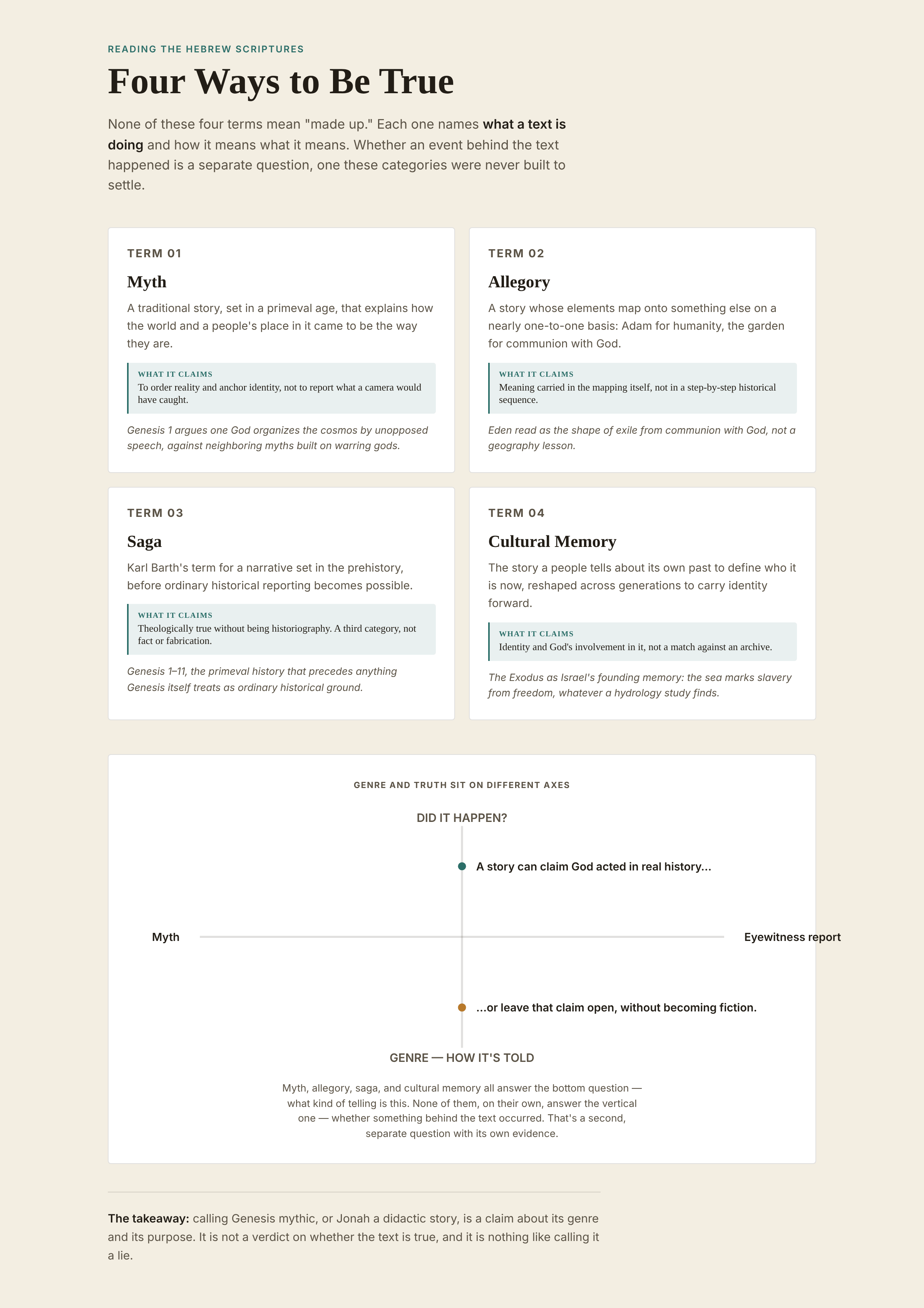
Click here for a larger version of this chart!
Endnotes
1. William Bascom, “The Forms of Folklore: Prose Narratives,” Journal of American Folklore 78, no. 307 (1965): 3-20, on myth as a traditional, primeval-age explanatory narrative.
2. David Galston, “Did Jesus Believe in God?” The Jesus Seminar and Beyond, Nov. 5, 2026.
3. Karl Barth, Church Dogmatics III/1, on Genesis 1-11 as saga.
4. Jan Assmann, Moses the Egyptian: The Memory of Egypt in Western Monotheism (Cambridge, MA: Harvard University Press, 1997).
5. John H. Walton, The Lost World of Genesis One: Ancient Cosmology and the Origins Debate (Downers Grove, IL: IVP Academic, 2009).
6. Meredith G. Kline, “Because It Had Not Rained,” Westminster Theological Journal 20 (1958): 146-57.
7. Peter Enns, The Evolution of Adam (Grand Rapids: Brazos Press, 2012) and The Bible Tells Me So (New York: HarperOne, 2014).
8. Philo of Alexandria, De Opificio Mundi (On the Creation of the World).
9. Origen, De Principiis IV.
10. Augustine, De Genesi ad Litteram (The Literal Meaning of Genesis).
11. Maimonides, Guide for the Perplexed, including his reading of Job as a parable addressing the problem of providence.
12. On the Gilgamesh and Atrahasis flood parallels, see Alexander Heidel, The Gilgamesh Epic and Old Testament Parallels (Chicago: University of Chicago Press, 1946).
13. On the Song of the Sea as archaic Hebrew poetry, see Frank Moore Cross and David Noel Freedman, “The Song of Miriam,” Journal of Near Eastern Studies 14, no. 4 (1955): 237-50.
14. On Yam Suph as “Sea of Reeds,” see Nahum M. Sarna, The JPS Torah Commentary: Exodus (Philadelphia: Jewish Publication Society, 1991).
15. Ronald Hendel, Remembering Abraham: Culture, Memory, and History in the Hebrew Bible (New York: Oxford University Press, 2005), ch. 4, “The Exodus in Biblical Memory.”
16. James Limburg, Jonah: A Commentary, Old Testament Library (Louisville: Westminster John Knox, 1993).
17. Babylonian Talmud, Bava Batra 15a-b.
18. Paul Ricoeur, The Symbolism of Evil, trans. Emerson Buchanan (Boston: Beacon Press, 1969; French original 1960).
19. N.T. Wright, The New Testament and the People of God (Minneapolis: Fortress Press, 1992).
20. Karen Armstrong, A Short History of Myth (Edinburgh: Canongate, 2005).
21. Rudolf Bultmann, “New Testament and Mythology” (1941), in Kerygma and Myth, ed. Hans Werner Bartsch (London: SPCK, 1953).
22. John Calvin, Institutes of the Christian Religion, 1.13.1.
A good reading for today. Thanks for the reminder about the 4 types of reading. I know that you are staying in your academic lane right now. And I am enjoying this refresher with the language of academics. Thanks 😊
Thanks for giving me the ability to look at these writings with new understanding of their value to telling the story of Israel without feeling like I have to be able to defend them literally before I can be considered a Christian (or a Jew). Also for clarifying the terms used, such as myth.