


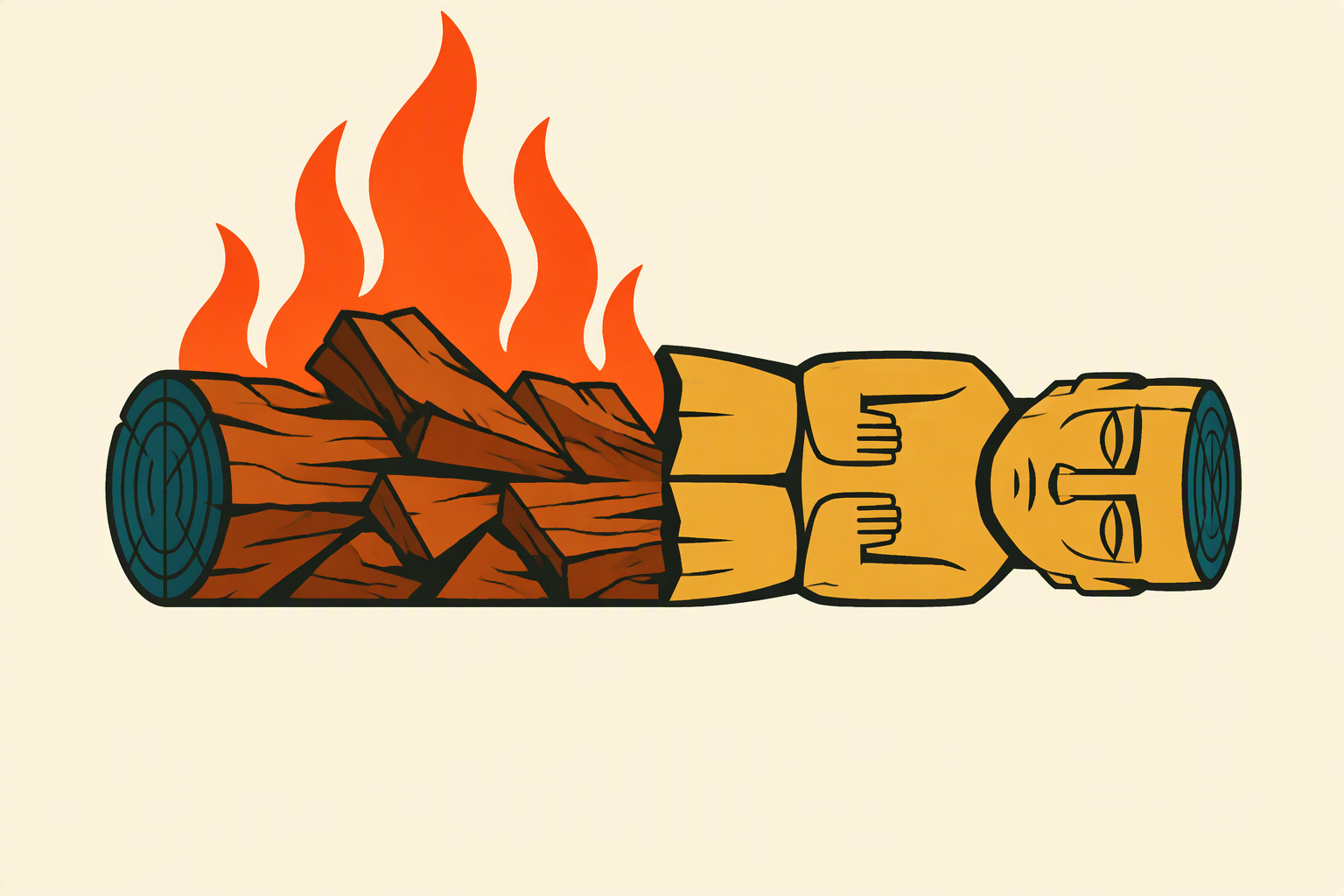
A man in Isaiah’s audience fells a tree. He splits the trunk. Half of it goes into the fire pit, where he roasts meat and warms his hands against the cold. He carves the other half into a god, sets it on a stand, bows down, and asks it to save him.¹ Isaiah narrates the arithmetic and lets the absurdity carry the whole thing. A man spent his afternoon deciding which end of the same log gets worshipped and which end gets burned for his dinner.
That’s likely the oldest description of idolatry on record, a sharper and funnier one than most modern examples tend to be. The passage is really about what happens when a person builds something with his own hands out of material he selected and shaped and controls completely, and then kneels in front of it expecting salvation. The object changes across centuries, of course, but the mechanics of it stay identical. American Christianity has been using Isaiah’s arithmetic for about a century and a half now, but with a printing press instead of a woodcutter’s knife, and has managed to call it reverence rather than what it actually might be.
I offered a version of this argument once already, working through Karl Barth’s case that Christ, not a doctrine of Scripture, sits at the center of the Christian faith.² That piece built the case from revelation outward, asking what Scripture can and cannot carry theologically. This one starts from Isaiah’s woodpile instead. What does an idol actually do for the person who builds it? Why does it work so well as a stand-in for God? And why does the Bible itself, at real length and more than once, warn against the exact activity a large share of American Christianity has spent the last century and a half perfecting?
Let’s go back to the woodcutter. He builds his own god, out of a tree he felled himself, and Isaiah lingers on every step, the measuring, the marking, the carving with a compass, the shaping into a human form, “beautiful like a human being.”³ Then the chapter turns the knife on him. The same craftsman who just roasted his dinner over half the log falls down before the other half and prays, “Save me, for you are my god.”⁴ Isaiah wants the reader to feel the vertigo of watching a man worship something he can personally account for down to the last offcut.
Paul makes the identical argument in Romans in more abstract language but with the same structure underneath. People who should have known better, he writes, “exchanged the glory of the immortal God for images resembling a mortal human being,” and a few verses later, “exchanged the truth about God for a lie and worshiped and served the creature rather than the Creator.”⁵ The verb is more important than the noun here. It isn’t that people chose a false god over a true one in some fair competition between the two. They traded, taking something they could measure and hold and fully control and swapping it in for something they couldn’t, because the second option asks far too much and promises far too little certainty in return.
This kind of substitution has a real, historical beginning, not just a vague sense of American Christianity drifting rightward over time. In 1881, A. A. Hodge and B. B. Warfield published a joint essay titled “Inspiration” in the Presbyterian Review, locating biblical inerrancy specifically in the “original autographs,” manuscripts that no longer exist and that nobody then living had ever seen.⁶ Before that essay, American Protestants had plenty of high views of Scripture, but not this particular formulation, airtight and located conveniently in documents no one could produce to check the claim against. Hodge and Warfield were serious scholars responding to serious pressures, Darwin and German higher criticism chief among them, and their actual argument was more careful than what later popularizers made of it. But the doctrinal shape they gave the Bible, inerrant somewhere just out of reach, is close to a century and a half old now, not exactly a timeless Christian truth handed down directly from the apostles.
That shape sells quite well. Study Bibles are marketed as inerrant and infallible right on the cover, in gilt lettering, as though the printing and binding process conferred a property no actual manuscript has ever possessed. Canon formation, translation committees, centuries of text-critical judgment calls made by fallible and situated human beings, all of that labor gets absorbed quietly into a finished product and handed to a reader as if God dropped it from the sky in pristine form. Nobody says it outright. The marketing copy says it all for them in more subtle ways. Inerrant. Trustworthy. God’s Word, bound right here, between these two covers, yours for $59.99 with your name embossed on the front cover too. A person built this object, every page of it, across two thousand years of human decisions. Then he was handed the finished product and taught to kneel in front of it.
The verse people reach for most often to make that marketing feel biblical rather than merely commercial is Hebrews 4:12, printed on coffee mugs and Bible-sleeve covers as proof that the book itself is a weapon, “the word of God is living and active, sharper than any two-edged sword.”⁷ The patristic tradition and a real line of modern scholarship read “word” here as logos in exactly the sense John uses it, meaning Christ, and some contemporary scholars continue to argue that identification directly.⁸ Even commentators who read the verse as pointing to Scripture generally, not to Christ, place it inside the writer’s extended argument about Israel in the wilderness and the warning from Psalm 95 to respond “today” while God’s voice is still sounding.⁹ The passage describes an address aimed at a listener in the present moment, not a bound object sitting inert on a shelf waiting to be cited at an opponent. A text that cuts into the person holding it, exposing what’s underneath, is doing the opposite of what an idol does. An idol sits still and lets you defend it. Using Hebrews 4:12 to deify a printed page gets the entire image backward. The same crowd quoting 2 Timothy 3:16 to settle an argument, a verse we’ve already dissected in some detail,¹⁰ tends to reach for Hebrews 4:12 right behind it, and neither verse is really doing what the marketing assumes.
Before going any further, the charitable version of the other side merits a mention. Sola scriptura began as a protest against a church hierarchy that had, in real and documented ways, abused its authority in order to control people. Wanting a fixed text that doesn’t bend to whoever currently holds power is a perfectly reasonable thing to want, especially for anyone who has watched a pastor or a denomination move the goalposts to protect itself. And for people rebuilding a life after real chaos, a text that holds still can function as a genuine mercy, not just a crutch. None of that gets erased by anything in this essay. What gets questioned is the narrower claim, that holding a text still requires declaring it beyond all human fingerprints, immune to every question, incapable in principle of containing an error. That particular position, not reverence for Scripture generally, is where the idol gets built.
What doesn’t get said often enough is that the idol is easier to live with than the God it replaces, and that ease is precisely the appeal. An idol doesn’t talk back. It doesn’t correct you or surprise you or ask anything of you beyond upkeep and defense. When Moses asks the voice at the burning bush for a usable name, something he can invoke and pin down, the answer he gets back is “I am who I am,” a name that refuses to function as a name, that slips out of his hand the moment he tries to close his fingers around it.¹¹ Jacob gets the same treatment at the Jabbok river. He wrestles an unidentified man all night, won’t release his grip until he’s given a blessing, and asks for a name in return. The answer comes back as a question thrown right at him: “Why is it that you ask my name?”¹² The God in these texts keeps declining to become an object a person can fully master. A book that nobody is allowed to question has no such problem. It sits still. It says what the reader already believes, because the reader is the one doing the reading, and it never once asks him to change once a reading is locked in.
Jeremiah caught this same substitution happening about a building instead of a book. He stood at the temple gate and listened to a crowd chanting “the temple of the LORD” back at him, over and over, like a charm meant to ward off consequences.¹³ His response wasn’t gentle. He told them the building guaranteed nothing, that God’s actual demand was for them to stop stealing, stop oppressing the vulnerable, and stop shedding innocent blood, and that no amount of chanting a sanctuary’s name would stand in for doing any of it.¹⁴ A sacred object, invoked loudly enough, was functioning as a hex against the one thing God had actually asked for. Swap “the Bible says it, I believe it, that settles it” into the same slot and the whole mechanism runs on exactly the same fuel. The phrase gets deployed as a wall against scrutiny, not as a report of anything the speaker has actually sat down and read carefully.
Another detail that’s often left out is no single fixed object exists anywhere for a person to make that claim about in the first place. No autograph of any New Testament book survives today, not one. What survives is thousands of handwritten manuscripts, copied across centuries by scribes working without printing presses or spell-check and, in a number of early cases, without much formal training at all, and those manuscripts disagree with each other. Bart Ehrman, who spent his career in New Testament textual criticism before writing about it for a general audience, has put the point as plainly as it can be put: there are “more variations among our manuscripts than there are words in the New Testament.”¹⁵ By his count the tally runs past 400,000 variants, against a Greek New Testament of roughly 140,000 words.¹⁶ Most of those differences are spelling, word order, the kind of thing a copyeditor fixes without a second thought. A real minority touch genuine theological stakes, and serious scholars disagree about how much weight that minority should carry. That disagreement is beside the point here though. The fixed, print-ready, beyond-question object people are being told to defend doesn’t exist as a physical artifact anyone has ever actually held. What exists is a long and human process of transmission, and the translation sitting on a shelf is the end product of that process, not a replacement for it.
Which raises the real question underneath all of this. If the text can’t settle an argument just by being quoted loudly at a room, who actually gets to decide what it means? Dan McClellan has made a public career on a point that sounds almost too obvious once it’s stated plainly. The Bible doesn’t say anything. People say things, using the Bible.¹⁷ His recent book opens by noting that “the Bible,” treated as one settled unit with a single coherent voice, is itself a far later construction than any of the texts collected inside it.¹⁸ A book declared beyond question, with no agreed interpreter standing over it, functions exactly like Isaiah’s log. Whoever carves the reading gets to install the god. That isn’t a minor technical wrinkle. It’s the actual mechanism by which scripture gets weaponized for one political or social cause after another, because the moment a text is deemed to be beyond scrutiny, the only live question left is who’s holding the carving knife.
None of this argument requires giving up on Scripture as sacred, or trustworthy, or worth a lifetime spent reading closely. It does, however, require giving up on treating a bound and printed object as though it could do for a person what only a person can actually do. An idol asks nothing of you beyond loyalty to the object itself. You defend its reputation, keep it on the shelf, cite it when it’s convenient, and that’s the entire relationship, start to finish. Ink can’t want anything from you. It can’t forgive you, call you by name, or ask you to change your life, and it has never once done any of those things no matter how many people have insisted otherwise from a pulpit. A person can do all of it. That asymmetry is the real case for John’s claim that in the beginning was the Word, and that this Word “became flesh and lived among us.”¹⁹ Not a scroll. Not a codex. Not a leather-bound KJV, NIV, ESV, or whatever your version of choice happens to be. A person.
Isaiah’s woodcutter never asked himself the obvious question. He burned half the log and worshipped the other half, and the text never records him noticing that as a problem. That has always been the risk with a god you built yourself. It never has to answer for the fire.
Endnotes
Isaiah 44:9–20 (NRSVue); the wood-splitting scene is narrated in vv. 14–17.
Shawn Patrick Connelly, “Beyond Bibliolatry: Barth’s Challenge to Evangelical Bibliocentrism and the Case for a Christ-Centered Faith,” Drink Wisely, April 7, 2026.
Isaiah 44:13 (NRSVue).
Isaiah 44:17 (NRSVue).
Romans 1:22–25 (NRSVue).
A. A. Hodge and B. B. Warfield, “Inspiration,” Presbyterian Review 2, no. 6 (April 1881): 225–60.
Hebrews 4:12 (NRSVue).
On the patristic and modern identification of the Hebrews 4:12 logos with Christ, see Harold W. Attridge, The Epistle to the Hebrews, Hermeneia (Philadelphia: Fortress Press, 1989), 134; James Swetnam, “A Close Reading of Hebrews 3,7–4,11 and Logos as Christ in Hebrews 4,12,” Melita Theologica 58, no. 1 (2007): 43–51. William L. Lane, Hebrews 1–8, Word Biblical Commentary (Dallas: Word Books, 1991), 103, represents the majority reading of logos as Scripture rather than Christ.
See the Psalm 95 warning quoted at Hebrews 3:7–11 and the surrounding argument through 4:11; cf. commentary on Hebrews 4:12–16, Working Preacher, noting that “the word of God” in context refers to God’s active proclamation rather than a direct reference to written Scripture.
Connelly, “Beyond Bibliolatry,” on 2 Timothy 3:16–17.
Exodus 3:14 (NRSVue).
Genesis 32:22–30 (NRSVue); the question is at v. 29.
Jeremiah 7:1–15 (NRSVue); the chant is at v. 4.
Jeremiah 7:5–9 (NRSVue).
Bart D. Ehrman, Misquoting Jesus: The Story Behind Who Changed the Bible and Why (San Francisco: HarperSanFrancisco, 2005), 10.
Ehrman, Misquoting Jesus, 10 and throughout; figures as commonly cited in discussions of the book.
Dan McClellan, The Bible Says So: What We Get Right (and Wrong) About Scripture’s Most Controversial Issues (New York: St. Martin’s Essentials, 2025).
McClellan, The Bible Says So, opening chapter.
John 1:1, 14 (NRSVue).
Thank you for the thoughtful essay. I have a feeling this topic is almost eternal … debated until someone returns to settle the matter.
It is thought-provoking to use the idols words to provide a convincing argument that the idol isn't exactly trustworthy, but that's actually the heart of the conundrum: the idolized book was meant to be interpreted, not idolized. Which, of course, requires work (something many Christians don't prefer).
When I lived in the certainty of evangelicalism, Biblical inerrancy was such an important foundation. It’s only been through welcome (& at times painful) deconstruction that the Word become flesh and his loving Father have taken center stage. And the mystery of God, his bigness, & being other than us have shown me how shallow and joyless that comfort of certainty was for me.
Thank you for your writings that stretch and convict and point to Jesus.