


I was told the Dead Sea Scrolls weren’t real; they weren’t true. Growing up, I heard that they couldn’t be trusted and that liberal scholars were using them to undermine the Bible and the faith. I remember it distinctly, mostly because nobody delivered it as an opinion at all. It was simply what we knew with certainty, filed right alongside all the other things we knew with certainty.
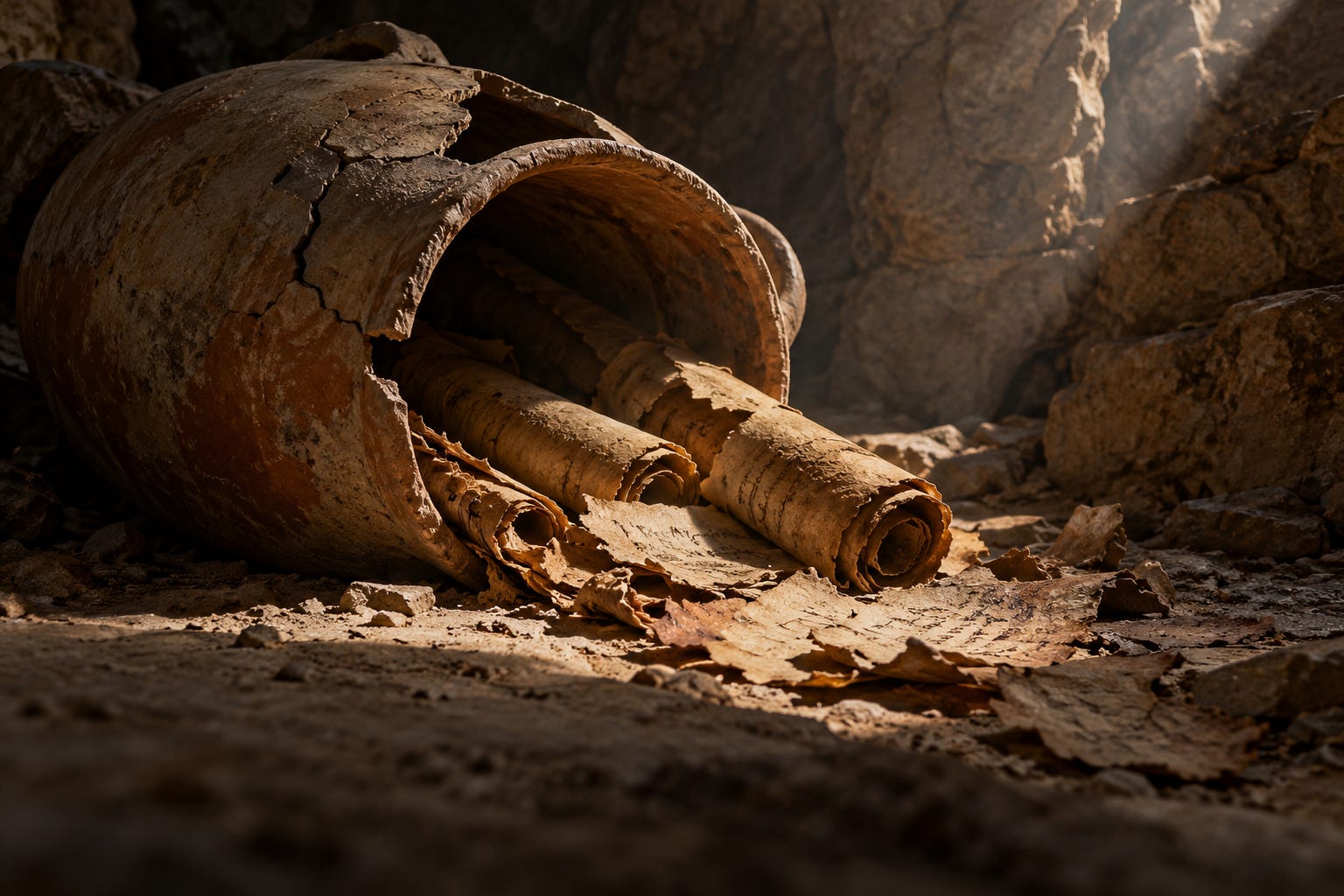
The scrolls are quite real. Bedouin herdsmen found the first of them in 1947, and eleven caves near Qumran eventually produced roughly 850 documents in many thousands of fragments.1 The collection includes portions of every book of the Hebrew Bible except Esther, copied between the third century BCE and the first century CE.2 When the Great Isaiah Scroll was announced in 1948, it predated the oldest complete Hebrew manuscript of Isaiah by about a thousand years.3
But the scrolls are really the second act. The narrative had been written decades before anyone climbed into those caves, and it starts with a basket of discarded parchment instead.
The first act
In 1844, a German scholar named Constantin von Tischendorf pulled forty-three leaves of a fourth-century Bible out of a basket at St. Catherine’s Monastery on Mount Sinai.4 He returned in 1859 and found most of the rest, including a complete New Testament. The manuscript ended up with the Russian tsar through an arrangement the monastery still contests.5 The Soviets sold it to the British Museum in 1933 for 100,000 pounds, which is a really strange journey for a manuscript that would later come to be known as Codex Sinaiticus.6
Sinaiticus changed what Greek New Testaments looked like. In 1881 Westcott and Hort published a Greek text built on the earliest manuscripts then available, and the committee behind the English Revised Version generally followed it.7 The text under the King James Version came from Erasmus’s 1516 edition, which rested on a handful of late manuscripts, none earlier than the twelfth century. That text and its descendants became known as the Textus Receptus, Latin for “received text,” a label that began as a publisher’s advertising line in 1633 claiming everyone had already accepted it.8 The label oversold the product in this case. Erasmus worked under pressure to beat rival editions and later admitted the result was precipitated rather than edited, and his only Greek manuscript of Revelation was missing its last page. Metzger reported that Erasmus filled the final six verses by translating the Latin Vulgate back into Greek, a point KJV defenders dispute in the details.9 Erasmus was also a Catholic priest, which complicates any story about the purity of the Protestant text.
The uproar over Westcott and Hort was immediate. John William Burgon, Dean of Chichester, answered in 1883 with The Revision Revised, a book-length defense of the traditional text, though he conceded in a footnote that the Textus Receptus needs correction.10
That is the accepted script. Older manuscripts arrive, they disagree with the KJV’s base text, and the reaction is to defend the old text along with an immediate search for motives as to why anyone would try to undermine it.
The twentieth century added papyri. P52, a scrap of John’s Gospel, is usually ranked as the earliest known fragment of the New Testament. Estimates run from 100 to 175 CE depending on whose paleography you trust, and some scholars would stretch the window into the early third century.11 The Chester Beatty codex of Paul’s letters, P46, most probably dates to around 175 to 225, and it shows Christians copying Paul in codex form well before the fourth century.12 The Bodmer papyri surfaced in Egypt in 1952 and gave us early copies of Luke and John, including P66 and P75.13 Several of these came through antiquities dealers, which is a legitimate red flag I’ll come back to shortly.14
What changed on the page
Start with 1 John 5:7. In the KJV it reads, “For there are three that bear record in heaven, the Father, the Word, and the Holy Ghost: and these three are one.” If original, that would be the clearest Trinitarian statement in the New Testament. It appears in only eight Greek manuscripts, all late, and is absent from nearly all the rest.15 Erasmus left it out of his first two editions because he couldn’t find it in the Greek. He added it in 1522 after critics attacked him, then shown a Greek manuscript he suspected had been prepared for the purpose of trapping him. The KJV inherited it through that third edition.16
Mark 16:9-20 hits harder for anyone who grew up in church, because the passage holds the resurrection appearances, the commission to preach to every creature, and the ascension. Without it, Mark ends with frightened women fleeing an empty tomb. Sinaiticus and Vaticanus both stop at verse 8, and the ESV and NIV both say so in a note.17 The defenders have a case. About 1,650 Greek manuscripts contain the longer ending against three that lack it, Irenaeus appears to quote it, and Vaticanus leaves a blank column after verse 8.18 The counting favors them less than it seems, because most of those manuscripts are late and belong to one text family.19 The passage also supplies the verses about handling snakes and drinking poison, which many churches that defend the ending would likely prefer not to practice.
The woman caught in adultery, John 7:53 to 8:11, is missing from P66, P75, Sinaiticus, and Vaticanus.20 Jerome knew Greek and Latin copies that had it, and some manuscripts place the story in Luke instead. Nearly every English Bible keeps it in John, usually with brackets or a note.21 This one carries weight because it holds the best-known act of mercy attributed to Jesus, the scene where he says, “He that is without sin among you, let him first cast a stone at her.” If scribes added it later, one of the most preached stories in the Gospels entered the Bible through copyists, not an apostle. Even translators who doubt the passage generally leave it where it stands, which suggests that familiarity holds a text in place more firmly than evidence does sometimes.
The Old Testament changes are quieter and stranger. Deuteronomy 32:8 in the KJV says God set the boundaries of the nations “according to the number of the children of Israel.” A Qumran Deuteronomy scroll and the Septuagint read “sons of God.” The ESV prints that and footnotes the Hebrew text, while the NIV 2011 keeps Israel.22 A Biblical Archaeology Society caption suggests scribes uncomfortable with any hint of other divine beings changed the original.23
A Samuel scroll supplies a paragraph before 1 Samuel 11 explaining why Nahash the Ammonite was gouging out right eyes. Josephus knew it too, and the NRSV puts it in the text. The KJV leaves it out entirely.24
Goliath is the one every Sunday school kid knows. The KJV puts his height at six cubits and a span, which is about 9’ 9”. The Septuagint, a Samuel scroll from Qumran, and Josephus all say four cubits and a span, which is about 6’ 9”, and the HCSB prints that reading in its text.25 Goliath lost a whole three feet and the Sunday school posters never updated accordingly.
Isaiah 53:11 adds “light.” In the Hebrew text the KJV followed, the suffering servant “sees” with nothing to see, a verb missing its object, and the KJV fills the gap with “the travail of his soul.” Three Isaiah scrolls and the Septuagint supply the missing word, and a United Bible Societies translation handbook says it seems to have been dropped by mistake from the Hebrew text. The CSB renders the line “he will see light and be satisfied,” and the NIV says “light of life.” The difference is more than cosmetic. Seeing light after anguish and death reads to many interpreters like life beyond the grave, and the KJV loses that thread entirely.26
The canon itself has a history too. The 1611 KJV printed the Apocrypha as a full section between the Testaments, and the British and Foreign Bible Society stopped printing it in 1826 or 1827, depending on the source.27
The KJV never asked for this job
The 1611 translators filled the margins with notes. Most offer alternative translations, and a small number flag different manuscript readings. One tally credited to the Victorian scholar Frederick Scrivener puts the New Testament total at thirty-seven, while a KJV-only defender counts twenty that clearly mark variants, so the number depends on who is counting.28 It is never zero, however. The translators defended marginal notes in their own preface.29 The text most people actually hold is the 1769 Oxford revision associated with Benjamin Blayney, not the 1611 original, and it changed spelling, italics, marginal notes, and some wording.30 Defending the 1611 as somehow untouchable or beyond reproach means defending a book whose makers did a good share of hedging in its margins.
Part of the untouchable reputation comes from the name. “Authorized Version” sounds almost like a verdict straight from heaven, and some laypeople in fundamentalism do assume God did the authorizing, when the only authority in view was an earthly king, and one account says there is no evidence James ever required it for all English churches.31 I suspect four centuries of sermons, hymns, and family Bibles finish that job, because a Bible nobody had to question gradually becomes a Bible nobody was or is allowed to question.
A lineage with a rotating villain
Historians don’t exactly agree on where the KJV-only position started. One account puts it at the backlash to the 1881 Revised Version and Burgon.32 Another points to Benjamin Wilkinson, a Seventh-day Adventist scholar who published Our Authorized Bible Vindicated in 1930, and to the Baptist fundamentalist David Otis Fuller, who spread its arguments in Which Bible?33 Peter Ruckman and Gail Riplinger carried it further.34 A review of Fuller’s book lists chapters on the Jesuit Bible of 1582 and three hundred years of attacks on the KJV, which reads as textual history staged as a long contest with Rome.35 In a movement that defines itself partly as in opposition to Rome, the story has an obvious payoff. It lets fundamentalists feel they are guarding the Protestant Bible against papists, even though the Greek text under the KJV came from a Catholic priest. KJV-only is a twentieth-century American invention, which makes it an odd choice for authorized guardian of the old paths.
The villain rotates between Rome, the Revisers, liberal professors, and forgers, and the plot never changes. One page I found online declares the scrolls forged and ties that claim to fragments in the Museum of the Bible’s collection. The Museum of the Bible’s sixteen fragments were declared forgeries in March 2020 by a report the museum itself commissioned, and those were pieces that surfaced on the antiquities market, not the legitimate scrolls from the caves.36
Why the fear inside the system
The theological pressure is the Westminster Confession’s claim that the Scriptures were “kept pure in all ages.”37 Advocates of confessional bibliology read that as a promise about the text itself, usually the Textus Receptus.38 The Chicago Statement of 1978 retreats to a safer, more defensible position by limiting inspiration to the original autographs, which it says can be recovered from existing manuscripts with great accuracy.39 Although I’m wont to add that we don’t have the original autographs themselves.
Whether that claim holds largely depends on the book. For the New Testament, the case is more respectable. Daniel Wallace, an evangelical textual critic, says roughly 70 percent of the variants are spelling differences and fewer than one percent are both meaningful and viable.40 But the passages in this essay live inside that small slice, and “great accuracy” sounds less comfortable when the question is where Mark’s Gospel ends, for example.
The Old Testament is harder, because there may be no single autograph to recover. The Septuagint’s Jeremiah runs about a seventh shorter than the Hebrew, and two Qumran fragments side with the shorter version, which suggests the book circulated in two distinct editions.41 Which edition is the inerrant original? Benjamin Laird, a New Testament scholar at Liberty University, argues that the original of a letter like Romans is better described as an original edition than as a single autograph, since ancient letter writers often had scribes produce several copies at once.42 It’s interesting that the people most likely to make “great accuracy” true are the same textual critics that fundamentalists deeply distrust.
That should make an inerrantist the scrolls’ biggest fan. Every manuscript is another chance to get a little closer to the original autograph. Make no mistake, the people who panic aren’t defending the Chicago Statement. They’re defending the page that’s in their lap, and that page is the KJV. They know it, they like what it says, and they resent any evidence that asks them to hold it more loosely.
The cultural pressure comes from what Christian Smith calls biblicism, a view in which the Bible is the single, clear, inerrant authority, and which still produces endless interpretive disagreement among its own adherents.43 My read is that a tradition with only a book can’t afford to have a book with a history. A tradition with a magisterium or a deep liturgical memory can absorb a variant, but one with nothing except the page in hand has no backup, so every variant looks like a direct attack on its only authority. That produces an all-or-nothing binary reflex. If Mark’s ending goes, what else goes?
Attacking the messenger is cheaper and often much more effective. Drink Wisely has previously explored what happens when the Bible gets treated as though it were somehow God himself, or when the right doctrine of Scripture stands in for the harder work of listening for the living Christ; a habit I like to call bibliolatry.46 I argued there that a perfect book is a tool for managing anxiety, which fits the pattern here, and that the way out is simply a better center. If Scripture is indeed witness to Christ, its history and development should be no threat to its role.
The cost of admitting something like this inside the confessional world is well documented. Westminster Theological Seminary suspended Peter Enns in 2008 after a two-year dispute over Inspiration and Incarnation, with the board chair saying the book fell outside the Westminster Confession. He and the school parted ways that August.44 That book was about the human side of Scripture, not even specifically about manuscripts.
The best version of their objection
Older doesn’t always mean better. One scholar of the Great Isaiah Scroll says its scribe was quite careless, and another Isaiah scroll sits much closer to the traditional Hebrew text.45 Textual critics weigh individual readings, not whole manuscripts, so “oldest wins” is a slogan, not a method, and fundamentalists are generally correct to say so. They are also right to be wary of the antiquities market, since P46 was bought from dealers with no archaeological context.14
None of that supports the claim that the scrolls are fake, however, and it certainly doesn’t make the KJV the final word or any more “authorized.”
Goliath loses three feet in the HCSB, and the churches that use it still meet on Sundays. The Bible survives having a real, human history. It’s really only those who insist that it never had one that have an insurmountable dilemma.
Endnotes and sources
1. Orthodox Wiki and Britannica Kids. Roughly 850 documents, discovered 1947 to 1956 in eleven caves near Qumran, first found in 1947 by Bedouin herdsmen. Fragment counts vary from 15,000 to 25,000, so the essay says “many thousands.”
2. Biblical Archaeology Society. Third century BCE to first century CE, portions of every Hebrew Bible book except Esther.
3. John J. Collins, The Dead Sea Scrolls: A Biography (Princeton University Press, 2013), as quoted at Times and Seasons. The April 1948 announcement said the Isaiah scroll was older than any other complete Hebrew manuscript of the book by about a thousand years.
4. Britannica and Catholic Encyclopedia. 43 leaves discovered in 1844 at St. Catherine’s. The basket detail comes from the Catholic Encyclopedia.
5. Britannica and Ehrman Blog. Several hundred more leaves in 1859, given to Tsar Alexander II in exchange for protection. The monastery still claims Tischendorf stole it.
6. Britannica. Sold to the British Museum in 1933 for 100,000 pounds.
7. DBTS, Dean Burgon. The Revised Version committee generally followed the Westcott and Hort Greek text of 1881, built on the earliest manuscripts available.
8. Virtual Religion primer, Zondervan Academic, Wikipedia, and DBTS. Erasmus based his edition on only a few late manuscripts, none earlier than the twelfth century (sources count three, six, or seven). The term comes from a 1633 Elzevir preface and began as an advertising blurb.
9. Virtual Religion primer, Bruce Metzger, The Text of the New Testament, pp. 99-100, as quoted on the B-Greek list, Reformation21, Confessional Bibliology, and UASV. Erasmus later quipped that the text was precipitated rather than edited. His Revelation manuscript lacked the last leaf, and Metzger says he supplied the last six verses from the Vulgate, which KJV defenders dispute in detail. Erasmus was a Roman Catholic priest.
10. DBTS. The Revision Revised appeared in 1883, and Burgon admitted in a footnote that the TR needs correction.
11. Wikipedia, Rylands Library Papyrus P52 and Brent Nongbri, “The Use and Abuse of P52,” Harvard Theological Review 98.1 (2005). C. H. Roberts, the original editor, proposed 100 to 150 CE, Orsini and Clarysse (2012) proposed 125 to 175, and Nongbri argues that any serious window must include the later second and early third centuries.
12. Wikipedia, Papyrus 46. Griffin (1996) gives 175 to 225 as most probable, with a 95 percent interval of 150 to 250. Proposals run from the mid-second century to the third. Young Kyu Kim’s date of about 80 CE (1988) has been widely rejected.
13. Wikipedia, Bodmer Papyri. Discovered in Egypt in 1952, with P75 containing most of Luke and John.
14. University of Michigan, Reading the Papyri. P46 was purchased on the antiquities market and lacks archaeological context.
15. Wikipedia, Johannine Comma. Absent from almost all Greek manuscripts, and Nestle-Aland knows of eight that contain it.
16. Wikipedia, Johannine Comma and Comma Johanneum mirror. Erasmus omitted it from his first two editions and added it in 1522, noting in a lengthy footnote his suspicion that the manuscript was prepared to confute him. The third edition became a chief source for the KJV.
17. BibleHub, GBC notes, and Faithlife commentary. Sinaiticus and Vaticanus omit Mark 16:9-20, the ESV and NIV carry notes, and verse 8 leaves frightened women fleeing.
18. Text & Canon. 1,653 Greek manuscripts include the ending, three end at verse 8, and Irenaeus quotes verse 19.
19. Puritan Board thread. Most manuscripts with the ending are later and belong to the Byzantine family.
20. BibleHub. P66, P75, Sinaiticus, and Vaticanus omit John 7:53-8:11.
21. BibleHub, A Plain Reading blog, Comerford, and Effectual Grace. Jerome found it in many Greek and Latin manuscripts, some manuscripts move it to Luke, and virtually every translation keeps it in John even though many translators would deny it a place in the text.
22. Biball and Biblia. The ESV reads “sons of God” with a footnote, the KJV reads “children of Israel,” and the NIV 2011 reads “sons of Israel.”
23. Biblical Archaeology Society. 4QDeutj and the Septuagint read “sons of Elohim,” and the caption suggests scribes uncomfortable with polytheism changed the text.
24. Wikipedia, 1 Samuel 11 and NET Bible note. 4QSama and Josephus attest the addition, and the NRSV adopts it.
25. Biblia, NC Register, and Reformation Study Bible. The KJV has six cubits and a span, the HCSB has four, and the Septuagint, Dead Sea Scrolls, and Josephus agree on four. The heights work out to about 9’9” and 6’9”.
26. Text & Canon and UBS Translation Handbook. Three Isaiah scrolls and the Septuagint read “he will see light,” and the handbook says the Hebrew text has no object for the verb “see” and the word seems to have been omitted by mistake. The reading of resurrection in the light imagery is an interpretation held by some interpreters.
27. Wikipedia, Apocrypha controversy and Logos forum quoting Britannica. The 1611 KJV placed it between the Testaments, and the society ended printing it in 1826 or 1827 depending on the source.
28. Sharper Iron and Grace Life lesson. Scrivener is credited with 37 manuscript-reading notes among 767 in the New Testament, and a KJV-only defender counts 20. Scrivener’s own account is F. H. A. Scrivener, The Authorized Edition of the English Bible (1611) (Cambridge, 1884).
29. Sharper Iron. The translators’ preface argued strongly for such notes.
30. Bible-Researcher, Printing history of the KJV and Eden blog. Twentieth-century editions generally reproduce the Oxford edition of 1769, which altered italics, spelling, marginal notes, and a number of readings.
31. Sharper Iron. Some laypeople in fundamentalism think God personally authorized the KJV, and there is no evidence King James ever authorized it for all English churches.
32. DBTS and Sharper Iron. One account traces KJV-onlyism to the 1881 Revised Version and Burgon, Kutilek traces it to Wilkinson, and another says it cannot be traced to a single school.
33. Wikipedia, Our Authorized Bible Vindicated. Wilkinson, a Seventh-day Adventist, published it in 1930, and Fuller adopted its arguments.
34. Sharper Iron and Biblical Training. Hills influenced Fuller and Ruckman, and Riplinger’s New Age Bible Versions appeared in 1993.
35. Free Presbyterian Church of Scotland review. The Wilkinson chapters include the Jesuit Bible of 1582 and three hundred years of attack on the KJV.
36. Michael Greshko, National Geographic, March 13, 2020. A report by Art Fraud Insights, commissioned by the museum, found all 16 of its Dead Sea Scroll fragments to be modern forgeries, and the findings do not cast doubt on authentic Qumran fragments. The page making the forgery argument is here, and see also Text & Canon.
37. Confessional Bibliology. WCF 1.8 says the Scriptures were “kept pure in all ages” by God’s singular care and providence.
38. Confessional Bibliology. Confessional bibliology regards the text as providentially preserved.
39. Place for Truth. Article X limits inspiration to the autographic text, which can be ascertained from available manuscripts with great accuracy.
40. Biblical Training lecture and TGC interview with Wallace. Around 400,000 variants, roughly 70 percent spelling differences, under one percent meaningful and viable.
41. Catholic Bible Student and BAS Library. Septuagint Jeremiah is about one seventh shorter than the Hebrew, and 4QJerb and 4QJerd agree with it.
42. J. W. Wartick, summarizing Benjamin P. Laird, Creating the Canon: Composition, Controversy, and the Authority of the New Testament (IVP Academic, 2023), pp. 49, 61-64. Laird proposes thinking of an “original edition” rather than a single autograph and suggests at least three copies of Romans were produced at the end of its composition.
43. Wineskins review. Ten reference points and “pervasive interpretive pluralism.”
44. Christianity Today, April 2008 and July 2008. The board chair said the book fell outside the Confession, and Enns’s service ended August 1, 2008, after fourteen years.
45. Érudit article. The Great Isaiah Scroll’s scribe was quite careless, and 1QIsab is much closer to the traditional Hebrew text.
46.Shawn Patrick Connelly, “Beyond Bibliolatry,” Drink Wisely, April 7, 2026
I’m curious. Why is it that people who are religious place so much emphasis on the unchanging nature of their foundational book. Whether the Bible, the Torah or any other, they have all been copied and passed down through generations of fallible humans. The likelihood of perfection being maintained through all those generations is miniscule ( assuming they were perfect to begin with). Add the political desire to have a script that supports the way in which people are governed and it’s hard to see how any near originals would survive unchanged. Why can’t these people follow Christ’s way? If you believe, the Sermon on the Mount, “love one another as you love yourselves” et al must be your life’s guide. It wouldn’t matter if you never opened the Bible again.
I’ve found that many people prefer to pick and choose verses, often out of context, to validate their personal prejudices and justify behaviors that are direct opposition to the Golden Rule. I think of them as worshipping a God made in the image of Man.