


In 1992, Wendell Berry stood up at Southern Baptist Theological Seminary in Louisville and told the room that Christianity had made its peace with an economy busy killing the world. So there’s that. He was a farmer from Henry County with no divinity degree and no plans to get one. I like that; we’re the same in that respect. He opened by admitting he had never been comfortable behind a pulpit, then preached anyway in the only form he knew and trusted.
An essayist, he said, is a writer attempting to tell the truth who gets to claim he was only practicing when he turns out to be wrong. That lecture became “Christianity and the Survival of Creation,” and it contains the sentence that should have ended the American church’s flirtation with industrial capitalism: the certified Christian, he wrote, is as likely as anyone else to sign on to the “conspiracy to murder Creation.”1 We’ve always done it, and we do it still.
Berry died Monday at his home in Port Royal, KY, at ninety-two.
I came to him late, which I deeply regret. All those years as an elder in a Reformed denomination and I cannot remember his name coming up once, not in session meetings, not in a study, not from a pulpit. We had Sproul and we had Keller and we had a whole apparatus for explaining why the world was the way it was. What we didn’t have was anybody insisting the world was holy, and that our habits were a theological problem in greater measure than an economic one.
He also gave me the best defense of the essay as a tool that I’ve ever read, and he did it in the least likely, perfect place. He introduced himself to those Southern Baptists as an essayist and a dissenter, which is a really bold way to open in a Baptist seminary chapel, and then explained the difference between his trade and theirs. A preacher has to be right or wrong. An essayist who turns out to be wrong can say he was practicing. Then he added the part that hits home: an essayist speaks without needing an institution to authorize him, and a dissenter speaks without any such protection at all.2
The line about practicing reads like modesty, but it’s actually a description of what the form is for. An essay is thinking done in public at the speed of a person changing his mind, with no obligation to arrive where it started, and no requirement that the writer already be the man or woman the argument implies. A sermon can’t operate that way. A formal confession of faith certainly can’t either. I sit down every week and try the thing again, and if I got something wrong in March I get to say so in September or next week without anybody convening a court or review. Berry worked like that for sixty years and never once seemed embarrassed about it. Again, I love that.
A Deeper Well has mostly gone looking for wisdom in bishops and monks and the occasional formidable sister. Berry was none of those things. He was a layman who wrote poems on Sunday mornings when the weather was too good to spend indoors, and who thought the Bible was written outdoors and ought to be read that way too.3 If the series is about people who saw something the institution had misplaced, he qualifies without an asterisk.
He was harder on the institutional church than most of the people who have actually walked out of one. Half of the aforementioned lecture is an argument that treating the sanctuary as the one holy address forces you to call everything else secular, which then licenses certified Christians to walk out the doors and plunder the world God made and called good. He pointed out that the most important religion in the Bible is unorganized and frequently hostile to organization, that its central figures are shepherds and soldiers and craftsmen and prisoners and prostitutes rather than priests, and that almost none of the decisive encounters in it happen indoors. This is incredibly insightful.
Modern Christianity, in his reading, had specialized itself into the same shape as every other modern institution, counting success in attendance numbers and devoting itself to the strange business of rescuing individual disembodied souls. He thought the logical end of that project was arriving in heaven to find you were the only one there, correct at last yet completely alone. Then he handed the microphone to Huck Finn, who looked at Miss Watson’s version of the good place and made up his mind he wouldn’t try for it.4
. . .
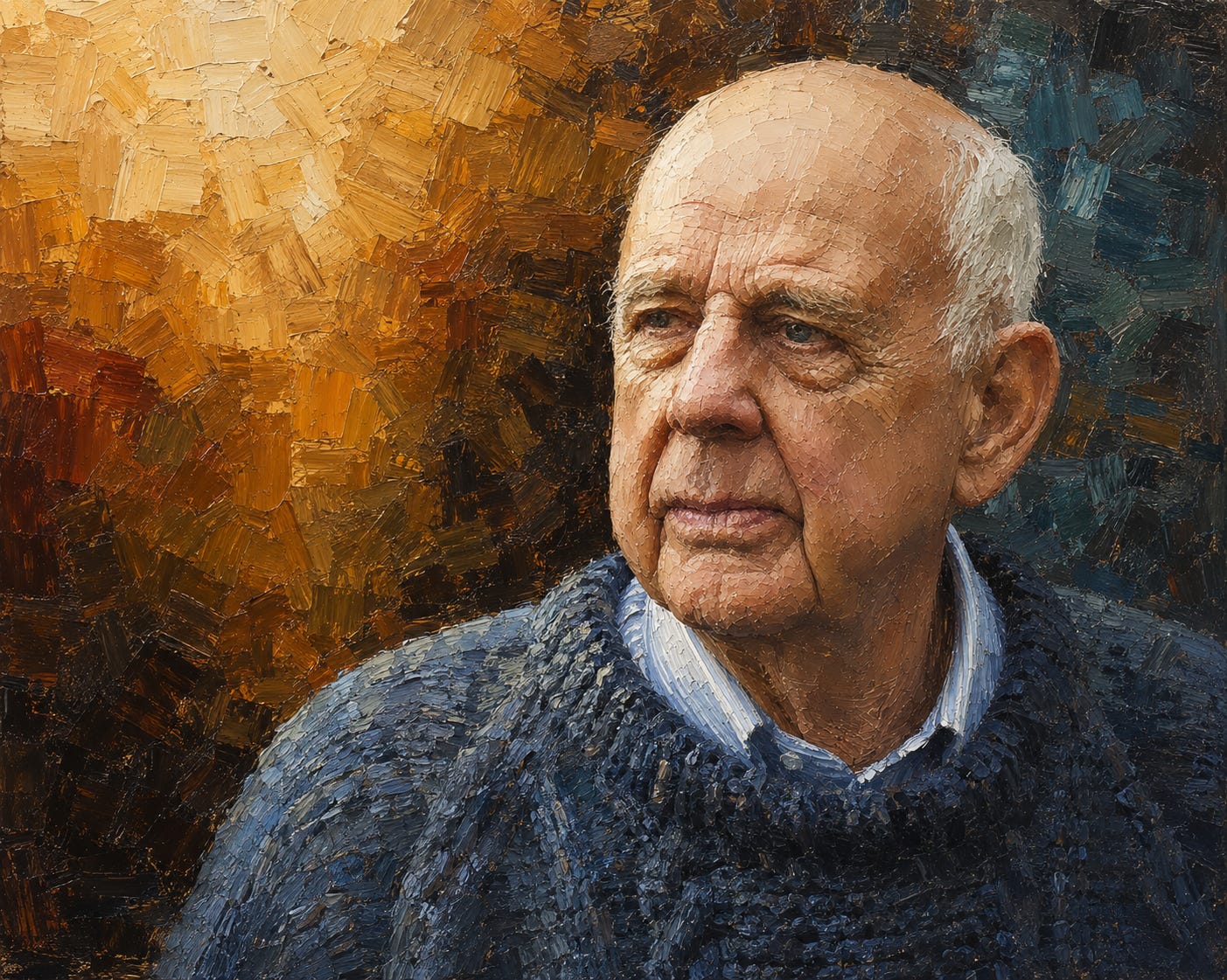
The political right spent forty years trying to recruit him, and it’s entertaining to watch how completely their attempt failed. He had all the surface markings of a right-wing man: rural, traditional, suspicious of the federal government, devoted to marriage and family and place. Conservative magazines ran the obligatory interviews. Front-porch conservatism’s good ‘ol boys built half their vocabulary out of his select sentences. But then he kept declining to play his assigned part as some honorary member of the tribe.
In 2009, the University of Kentucky, his alma mater and former employer, accepted seven million dollars from a coal magnate and renamed a basketball dormitory the Wildcat Coal Lodge. Berry promptly withdrew the personal papers he had loaned the school. The university, he said, had sold an advertisement.5 He marched on the Capitol Power Plant the same year, and when someone asked whether he wanted to get arrested, his answer was that he did not want to, but he was willing, because nothing else was working.6 He had already been arrested once, in 1979, for trespassing at the Marble Hill nuclear plant in southern Indiana, the only arrest of his life.7 In 2011, he joined a sit-in in the governor’s office over mountaintop removal. This is not the resume of a man who wanted the Republican Party to rule the day.
Then there was the subject of marriage. In 2013, he published an essay in The Christian Century explaining why he would not lend Christian authority to a legal campaign against gay couples. His argument was that rights precede governments rather than being dispensed by them, which is about as close to a true conservative first principle as you can get, and he aimed it squarely at the people who had spent two decades assuming he was one of theirs. He never was. He wrote in that same essay that the present political atmosphere assumes everyone belongs to one of two sides, and that he found himself in disagreement with both of them, most sharply when either side wanted the government to enforce private moral responsibility.
His conclusion was that Christians insisting on enforcing their marriage doctrine through laws were participating in a culture of violence.8 Evangelical readers who had been quoting him about things like topsoil for twenty years discovered they had been quoting a man who actually meant what he said.
That is the corrective Berry brings, and it is why his brand of opposition landed harder than all the bluster and shouting does. He never argued from a standpoint of grievance. He argued from a settled account of what a human life is for, and the loud self-interest of the modern right simply did not survive that.
You cannot be angry at Wendell Berry for being angry, because he wasn’t angry. He was just unimpressed. And I love it.
. . .
He never used the word deconstruction and would have found most of the discourse around it rather exhausting, I’m sure. No memoir about losing his religion, no arc from certainty to freedom, no announcement of departure from the institution. What he had instead was a charge set at the base of the entire structure. The split he spent his life attacking, the one between spirit and matter, religion and economy, worship and work, is the same split holding up the building the rest of us grew up in. Pull it apart and see what remains standing.
If the ground is holy, the brick and mortar sanctuary stops being the only address God keeps. If creation participates in God rather than sitting outside him as inventory, then all that fallen-world talk that let us shrug at strip mines and poisoned creeks stops working as theology and starts working only as a cheap alibi.
He also told those Baptists he owed a considerable debt to Buddhism, and then declined the exit anyway. Christianity was “his native religion, for better or worse,” learned before he was conscious of learning it, lodged in his language and his dreams. You can turn away from a thing like that, he said, but turning away only binds you to a smaller version of it.9 So he stayed and worked on it. A Baptist layman stood in the flagship seminary of the Southern Baptist Convention, told them their religion needed rebuilding from the foundation, and made clear he had no intention of leaving while the work got done.
What he offers the deconstruction crowd, mine included, is the thing most of us are often lacking the most. He had somewhere solid to stand. He was not organized around what he had walked away from. He had a farm, a county, a marriage, a river, and a set of obligations that did not care what conclusions he had reached about substitutionary atonement or the nature of the Trinity.
This is maybe Berry’s most critical lesson to us. Take all that away and deconstruction becomes its own kind of denomination soon enough, with its own shibboleths and a comment section to enforce them. All we’re doing, at that point, is just replacing one institution for another one. Berry avoided that, because his life was never an argument in the first place. It was the place he lived, and the writing was just an honest accounting of it all.
. . .
He also got things wrong sometimes, being human and all, and any memorial would be incomplete without acknowledging that. He described Robert E. Lee as more a tragic figure than a defender of slavery, for example, and he and his wife sued the University of Kentucky in 2020 to stop the removal of a Depression-era mural criticized for sanitizing the region’s history of slavery.10 A man who built an entire philosophy on the moral weight of staying put will sometimes defend the place he stayed in past the point where it deserves defending.
The loyalty that made him incorruptible on something like coal made him stubborn in this regard too. Both come from the same root, and you don’t get to keep one and discard the other with any consistency. He’d have granted me the point, I think, on the same terms he granted himself. Sometimes you’re wrong and you were practicing.
. . .
He wrote once that we should beware the machinery of longevity, that when a life is over the decent thing is to die, and that the forest does not hold itself back from death.11 Ninety-two years, more than forty books, one hillside farm in Henry County that he worked for four decades. He kept warning us that the industrial arrangement was a bargain we had not read closely enough, and he was mostly ignored by the people best positioned to do something about it, which is the standard fate of anyone who tells a comfortable institution the truth about itself.
He was not a trained theologian. He simply thought the ground he farmed participated in God, and he refused to write a single sentence that pretended otherwise. Many of the professionals I read never got that far.
Endnotes
1 Wendell Berry, “Christianity and the Survival of Creation,” delivered as a lecture at Southern Baptist Theological Seminary, Louisville, 1992; published in Cross Currents 43, no. 2 (Summer 1993); collected in Sex, Economy, Freedom and Community (Pantheon, 1993) and The Art of the Commonplace: The Agrarian Essays of Wendell Berry (Counterpoint, 2002).
2 Berry, “Christianity and the Survival of Creation,” opening paragraph.
3 Berry describes the Bible as a hypaethral book, open to the sky, and best read outdoors, in “Christianity and the Survival of Creation.” For the Sunday poems, see A Timbered Choir: The Sabbath Poems 1979-1997 (Counterpoint, 1998).
4 Berry, “Christianity and the Survival of Creation.” The closing allusion is to Mark Twain, Adventures of Huckleberry Finn, which Berry quotes at the end of the same passage.
5 Kentucky Kernel, quoted in Sarah Ladd, “Kentucky writer, farmer and advocate Wendell Berry dies at 92,” Kentucky Lantern, August 31, 2026.
6 Inside Climate News (2009), quoted in Kentucky Lantern, August 31, 2026.
7 Kentucky Lantern, August 31, 2026. Berry recounts the Marble Hill action in “The Reactor and the Garden,” collected in The Gift of Good Land (North Point Press, 1981).
8 Wendell Berry, “Caught in the Middle: On Abortion and Homosexuality,” The Christian Century, March 20, 2013; revised and collected as “Caught in the Middle” in Our Only World: Ten Essays (Counterpoint, 2015).
9 Berry, “Christianity and the Survival of Creation.”
10 Associated Press obituary, August 31, 2026.
11 Quoted in Kentucky Lantern, August 31, 2026.
Well said.
In a word, Wendell Berry was "grounded." So may we all strive to be.
I also came to Wendell Berry late in life. I'm 83 and my daughter introduced me to Jayber Crow a few years ago. I've lived my life differently than Wendell (or Jayber) and never stayed in one place very long. But I've found God in the desert and the forest as often as in the sanctuary of the church. RIP Wendell Berry. You've taught me much!