


The word you think you know
Say “hell” in any American room and everyone pictures basically the same place. Fire, darkness, a vast chamber under the earth, the screams of the damned, maybe even a pitchfork if the imagination turns cartoonish. That picture is remarkably stable across denominations, politics, and levels of church involvement. Here is the problem, however. The Bible never describes that place.
Open a King James Bible and you will find the word “hell” a whopping fifty-four times. Those fifty-four appearances translate four different words. Sheol, a Hebrew word for the grave. Hades, its Greek equivalent. Gehenna, the name of a ravine southwest of Jerusalem. Tartarus, a word borrowed from Greek mythology that appears exactly once.1 Four words, four histories, yet one English rendering for all of them. The merger of the four happened in the translator’s room, and the doctrine most of us are familiar with relies on that merger at least as much, if not more, than on the words themselves.
For starters, the word “hell” is itself an import. It came to the English language from the old Germanic world, from helan, to cover or conceal, the hidden place of the dead, kin to the Norse realm of Hel.2 The translators chose the word that their readers already knew, and that word brought its own baggage with it.
I believed in the place that word conjures for most of my life. I taught it and defended it, yet it never rested easy with me, although I assumed the problem was my own squeamishness and sense of justice. It took me an embarrassingly long time to actually look up the words and think through their respective origins and meanings. This guide is the walk-through I wish someone had given to me thirty years ago. So, clearly, the idiot in the title of this piece is me.
One housekeeping note to begin. Drink Wisely has covered the doctrine of eternal conscious torment elsewhere, in “The Hell We Think We Know,” which works through the hard proof-texts in some detail.3 This piece is the companion field guide, of sorts, covering the words themselves, where each came from, and what follows from that once you can distinguish them. By the end of this essay, I will argue that none of these words supports a belief in an eternal hell, and that the Bible’s last word on the subject is actually an open gate.
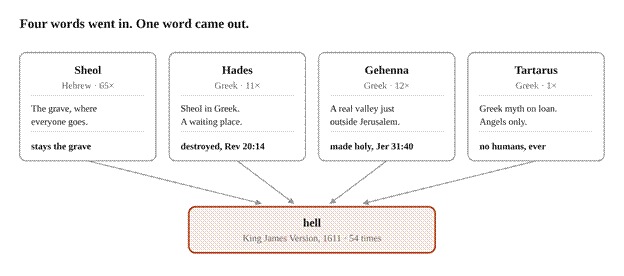
Here is a visual representation of the merger I’m articulating at a glance; the guide takes it one word at a time from here.
Sheol, where everybody goes
Sheol appears sixty-five times in the Hebrew Bible, and the first thing to know about it is that absolutely everyone ends up there. Yep. Everyone. Jacob expects to go down to Sheol mourning his son (Genesis 37:35). Job asks to hide there until God’s anger passes (Job 14:13). The psalmist’s life “draws near to Sheol” (Psalm 88:3). Qoheleth is blunt about the amenities: “there is no work or thought or knowledge or wisdom in Sheol, to which you are going” (Ecclesiastes 9:10). Note the pronoun here; you are going. Righteous and wicked alike descend to the same silent, shadowy place, which is why the honest and best translation most of the time is simply “the grave.” None of us escape it.
The King James translators could not decide what to do with the word, and their indecision gives their entire game away. They rendered Sheol as “hell” thirty-one times, “grave” thirty-one times, and “pit” three times.4 When Jacob goes down, the KJV gives him “the grave” (Genesis 37:35). When the wicked go down, they get “hell” (Psalm 9:17). The Hebrew underneath is the same word, and the differentiating was done in 1611, in England, by a committee. Watch the direction of that sorting closely. An established belief about hell was retrofitted into the translation itself, with doctrine selecting the vocabulary.
Try the swap test for yourself. Psalm 16:10 in the KJV has David praying, “thou wilt not leave my soul in hell.” Read it as printed and David apparently expects a stay in eternal conscious torment, which is a strange thing for the man after God’s own heart to assume in passing. Put “the grave” back in there instead and the verse becomes what it is intended to be; a prayer about death and rescue from it.
No one in Sheol is being punished. Across roughly a thousand years of its composition, the Hebrew Bible develops no doctrine of postmortem torment, with one late and partial exception, Daniel 12:2, which arrives in the second century BC and will come up again below.
Hades, Sheol with a Greek accent
When Jewish scholars translated their scriptures into Greek in the centuries before Jesus, they rendered Sheol with the word their Hellenistic neighbors used for the realm of the dead, which is Hades. The New Testament inherits that same choice. Hades appears eleven times and behaves the same way Sheol does, as the holding place of the dead with no punishments to be found.5
Two additional details are critical here. First, when Peter preaches at Pentecost, he quotes Psalm 16:10, the swap-test verse, with Hades standing exactly where Sheol stood (Acts 2:27). The apostles understood the two words as equivalent because they were equivalent. Second, Hades comes with a terminal date. At the climax of Revelation, “Death and Hades were thrown into the lake of fire” (Revelation 20:14). Whatever Hades is, we know it ends. The place the KJV calls hell gets destroyed before the story is over, which is really awkward for a supposed eternal destination.
Some will object that being thrown in says nothing about being destroyed, and that Death and Hades might smolder in the lake forever. Revelation refutes that reading in the same verse, glossing the event as “the second death,” and Paul had already called it: “The last enemy to be destroyed is death” (1 Corinthians 15:26). The throw here is certainly an execution; no indication of eternal duration.
The rich man and Lazarus (Luke 16:19-31) is set in Hades, and it is maybe the strongest card in the infernalist’s hand, although less so knowing what Hades actually means. Drink Wisely takes it apart at length in the aforementioned parent essay to this one. The short version is that a parable aimed at wealth and deafness to Moses makes for a really poor description of the afterlife, and its setting is Hades, which as we just established has an end date of its own.
Gehenna, the valley you can walk to
Eleven of the twelve New Testament uses of Gehenna come from Jesus, which is why preachers love to say that Jesus talked about hell more than anyone.6 What he talked about was Gehenna, and Gehenna is, historically, a place on the map. The Valley of Hinnom, ge-hinnom, is a ravine curling around the southwest wall of Jerusalem. You could stand in the temple courts and walk there, downhill, inside of a half an hour. His contemporary audience heard a place named with a known history and location, roughly the way an American ear hears Gettysburg or The Alamo.
The history of this place progresses in four movements of fire.7 Under the kings Ahaz and Manasseh, the valley hosted the cult of Molech, where children were burned alive, a practice God condemns through Jeremiah with the startling disclaimer that it “did not come into my mind” (Jeremiah 7:31). Josiah desecrated the shrines so the burning would stop (2 Kings 23:10). Jeremiah then stood in that valley and promised that Jerusalem’s sin would end with the city aflame and the ravine filled with its dead, a prophecy Babylon fulfilled in 587 BC (Jeremiah 19). After the exile the defiled valley kept its reputation for corpses and burning, the scene behind Isaiah’s closing image of bodies outside the city whose “worm shall not die” and whose “fire shall not be quenched” (Isaiah 66:24).
So when Jesus warns that the whole person can be thrown into Gehenna (Matthew 5:29-30), or tells the Pharisees their converts are becoming children of Gehenna (Matthew 23:15, where the NRSVue prints “child of hell” and proves this essay’s point), he speaks the way Jeremiah spoke. The warning is prophetic and historical, aimed at a city on a collision course with an empire.
In AD 70, Rome did to Jerusalem what Babylon had done, and the valley earned its name again.
A second tradition grew alongside the prophetic one, in the apocalyptic writings between the testaments, where Gehenna breaks free of an actual geography and becomes a postmortem destination. Even there the picture refuses to become clear, however. The Enochic literature, a body of Jewish apocalypses from the last centuries before Christ, popular enough that Jude quotes it yet absent from Protestant Christian canons, tries out eternal torment, outright annihilation, and purification by turns, and the rabbis of the Talmudic era, the teachers whose debates were compiled in the centuries after the temple fell, commonly capped a sinner’s stay in Gehenna at twelve months, with early release for repentance and rescue by the God who “brings down to Sheol and raises up” (1 Samuel 2:6).8 So then, the notion that hell might have an exit was not a liberal innovation after all. It was a rabbinic assumption.
One correction to the sermon all of us probably heard, and that I repeated myself. Gehenna was never Jerusalem’s perpetually burning garbage dump. No evidence for the dump exists from the Second Temple period; the image traces to Rabbi David Kimhi, writing around 1200 AD, more than a millennium after Jesus.9 The valley’s associations with corpses and fire are real and far older. The municipal landfill with the undying flame is medieval commentary, at best. If a detail that vivid could ride along unchallenged for eight centuries, it is fair to ask what else has done the samething. And this correction costs Jesus’ warning nothing. His reference stood on Jeremiah and on fires that had actually burned there, landfill or no landfill.
Tartarus, briefly
The fourth word appears only once, as a verb. Second Peter says God consigned the rebel angels to Tartarus to be held for judgment (2 Peter 2:4). Tartarus is on loan from Greek mythology; the pit below Hades where Zeus locked up the Titans, and Peter borrowed it without apology.10 No human being is recorded as having been sent there anywhere in scripture. One of the Bible’s four hells has nothing to do with you at all, then, unless you happen to be a fallen angel, in which case I have another essay queued up for you.
The supporting cast
A few more images usually get lumped into the popular picture of hell too, and each gets a quick review.
The abyss, abussos, is a prison. Demons beg Jesus to be spared it (Luke 8:31), the beast climbs up out of it, and an angel locks Satan inside it for a thousand years (Revelation 20:1-3). Nobody is tortured in the abyss. It has a lock, not a furnace.
The lake of fire belongs to the book of Revelation, and what goes into it requires our close attention. The beast and the false prophet, then the devil, then Death and Hades themselves, and finally “anyone whose name was not found written in the book of life” (Revelation 20:15). The text calls it “the second death” (Revelation 20:14), a phrase that sounds a lot like an ending. And the strangest item on that list, the lake of fire, is where hell goes to die. Two conclusions follow from that observation. Death and Hades can hardly be tormented, since neither is a creature; the scene is picture language for abolition, the death of death, what John Donne compressed into “Death, thou shalt die.” And a lake that disposes of hell cannot also be hell under a new name. Revelation is painting the end of the underworld, in the underworld’s own colors, as its genre is wont to do.
Outer darkness, with its weeping and gnashing of teeth, closes three of Matthew’s parables (Matthew 8:12; 22:13; 25:30). Darkness, this time, without a flame in sight. The Bible’s judgment images contradict one another on the basic scenery, and that disagreement is itself instructive for us here. Prophets paint warnings, use imagery, and nobody should mistake the paintings and images for literal blueprints.
Two Greek words that decide the argument
Strip away the geography and the case for an eternal hell narrows to two Greek words found in one single verse. Matthew 25:46 reads, in most English Bibles, “these will go away into eternal punishment, but the righteous into eternal life.” The words are aionios and kolasis and each one says less in the Greek than the common English translation implies.
Aionios is the adjective form of aion, an age, an era, or a span with a beginning and an end. English still uses the loanword, eon. Whether aionios means “eternal” in the absolute sense or “belonging to the age to come” is very much a live scholarly question, and David Bentley Hart, whose New Testament renders the phrase “the chastening of that Age,” argues the word never unambiguously means endless duration.11
The sharper observation concerns the word the writers left unused. Greek had a term for strict, absolute eternity, aidios, and the New Testament uses it exactly twice, once for God’s eternal power (Romans 1:20) and once for the chains on the fallen angels (Jude 6). It is never applied to the punishment of a human being. The precise word existed, and on this subject the writers chose not to use it.
Kolasis, the noun behind “punishment,” began as a gardener’s word for pruning, and in classical usage it meant corrective punishment, discipline aimed at the good of the one punished. Greek kept a separate word, timoria, for retribution that satisfies the punisher, and Aristotle distinguishes the two explicitly. Matthew chose kolasis.12
Now a concession on my part. The standard lexicons list “eternal” as a legitimate sense of aionios, and most translators read Matthew 25:46 as a straight parallel.13 Hart’s reading also cuts both ways, and he admits it. If the punishment of the age is finite, the life of the age wears the same adjective, and his answer, that the Age to come describes a quality of participation in God and no stopwatch at all, has to cover both halves of the verse. The lexical evidence opens the door without definitively settling what lies beyond it. For that you need to consider the shape of the whole story, in its context both Biblically and historically, which is what I hope to do next.
How four words became one word
Between the testaments, Jewish writers under Persian and then Greek rule began filling in what the older scriptures had left unsaid about the dead, which was quite a lot actually. Resurrection to judgment enters the canon late, in Daniel 12:2, and the apocalypses that follow experiment freely; First Enoch alone contains eternal torment, outright annihilation, and purification within one collection.14 The raw material of our modern concept of hell was assembled during this period, as rival proposals, with no definitive verdict. Notice the irony in this. Much of the modern picture of hell was derived from books, Enoch chief among them, that the churches holding the doctrine most fervently have never acknowledged as canonical.
Jerome’s Latin Vulgate then provided the West a single word, infernum, the lower regions, to cover the Hebrew and Greek variety. Augustine, in book 21 of The City of God, argued for torment without end and argued it well, and his authority basically ended the question across the Latin church, though the Greek-speaking East never closed it with the same level of finality.15 The medieval imagination supplied the set design; Dante the architecture, the sermon tradition the smell of sulfur. By 1611, the word “hell” had become shorthand for a thousand years of received imagery, and the King James translators applied it to all four words. The modern doctrine of eternal conscious torment is a synthesis assembled across those centuries from selected texts. The doctrine is significantly younger than the words underneath it. Dan McClellan compresses the whole survey into one sentence I’m fond of for its accuracy and brevity: “There’s no one, consistent concept of Hell in the Bible.”16
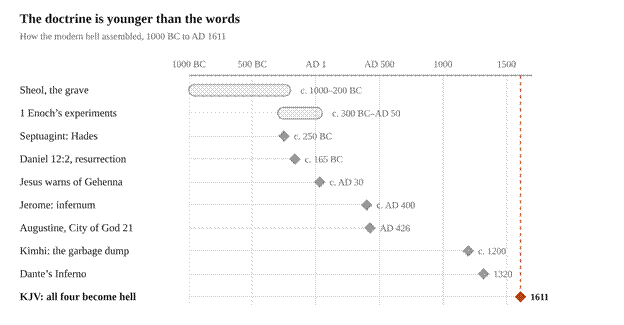
The spacing makes the argument on its own in this chart: the words come first, and the doctrine keeps assembling and evolving for another two thousand years.
Check your own Bible
The retreat from the old habit is visible on your own shelf.17

Modern committees have quietly walked back most of this merger. The ESV and the NRSVue transliterate Sheol and Hades, letting the Hebrew and Greek show through, and the NIV retreats to “the realm of the dead.” Look at what survived, though. Every one of them still prints “hell” for Gehenna, a literal, physical valley south of Jerusalem’s Old City, and most still print it for Tartarus, a Greek myth. Inexplicably, the words with the least claim to the translation are the ones that kept it. Habits of a thousand years die hard, even in - and maybe especially in - committees.
Where I land, and why it matters
A guide like this could stop at the taxonomy, and three of these positions do have serious advocates. Infernalists hold that the lost suffer consciously without end, and the strongest of them argue it from the Matthew 25:46 parallel and the torment passages of Revelation.18 Annihilationists hold that the lost are finally destroyed, an end rather than an endlessness, and they can point to the destruction language Jesus actually favored; Bart Ehrman, who has no theological horse in this race, reads the historical Jesus that way.19 Universalists hold that judgment is real and remedial and that in the end God loses no one.
I held the first position for most of my life. I hold the third one now, and I would rather argue for it directly than simply offer my readers an a la carte menu.
Start with the trajectory of the words at issue. Sheol is simply the grave. Hades is the grave in Greek, and Revelation throws it into the lake of fire and destroys it. Gehenna is a cursed valley, and Jeremiah, the prophet who made it a byword, ends his Hinnom prophecies with a promise that the valley of corpses and ashes “shall be sacred to the LORD” (Jeremiah 31:40).
Every hell in the Bible is a grave, a ruin, or a place with an ending written into its story.
Then Paul, in the passages where he writes most deliberately about the reach of salvation. “Just as one man’s trespass led to condemnation for all, so one man’s act of righteousness leads to justification and life for all” (Romans 5:18). “For God has imprisoned all in disobedience so that he may be merciful to all” (Romans 11:32). “For as all die in Adam, so all will be made alive in Christ,” until the end, when God is “all in all” (1 Corinthians 15:22, 28). You can, of course, decide the second “all” in each of these sentences is smaller and means something different than the first, but the grammar gives you no reason to do so.20 Your presuppositions might.
Then there’s the character question, which really clinches it for me. Scripture says God is love (1 John 4:8). It describes God’s wrath many times and never once says God is wrath. Love is who God is, and wrath is how that love reads from the wrong side of it. Punishment that corrects; that improves, belongs to that God, and kolasis means correction. Torment that never ends corrects nothing and serves no one, including the God supposedly administering it. Follow the logic one step further and eternal torment makes God the everlasting sustainer of torment, which is to say of evil. Thomas Talbott has pressed this point for decades, arguing that a Father whose justice and whose love pull in opposite directions is a Father divided against himself.21 I think he is surely right.
None of this makes judgment a fiction. The warnings are serious because the fire is serious, and I take Gehenna to be what Jesus’ imagery suggests, the refiner’s fire, the full and unsparing exposure of everything we have made of ourselves. George MacDonald called it the consuming fire and expected it to hurt.22 Grace, as I read the whole arc, gets resisted constantly along the way but finally resisted never. The only thing in this story that burns forever is God, and scripture calls that fire love.
The gates that never shut
In the New Jerusalem, “its gates will never be shut by day—and there will be no night there” (Revelation 21:25). The kings of the earth, last seen making war on the Lamb, walk in and bring their glory with them (Revelation 21:24). Outside the city stand the sorcerers and murderers and everyone who loves a lie (Revelation 22:15), and toward that outside the Spirit and the bride keep saying, “Come” (Revelation 22:17). Inside, the tree of life puts out leaves “for the healing of the nations” (Revelation 22:2). The last page of the Bible is a city with its doors propped open and the invitation still going out.
Bradley Jersak, whose mapping of the Gehenna traditions this guide leans on heavily, is careful about what the vision entails. The hope is rather specific. Entry still runs through washed robes (Revelation 22:14), the open gate is Christ’s, and no one gets to wave the crowd through on a whim.23 I will take one step past Jersak’s hopeful reticence, since I promised to be forthright here. I expect those gates to do what open gates do, and I expect the love holding them open to outlast and overcome every single refusal still walking around outside them. I expect Christ to win it all and, by all, I mean all.
Jeremiah saw it first. The valley where the children burned, the ravine that gave hell its only real geography, ends up being sacred to the LORD. If God can do that with a valley, I like the odds for his image-bearing creation.
Endnotes
1. In the KJV, “hell” appears 54 times, translating Sheol (65 occurrences: hell 31, grave 31, pit 3), Hades (11 occurrences: hell 10, grave 1 at 1 Corinthians 15:55, where modern critical editions read “death”), Gehenna (12), and the verb tartaroo (1). Counts follow standard concordance tabulations, cross-checked November 2026.
2. Oxford English Dictionary, s.v. “hell”: Old English hel, from a Germanic root meaning “to cover, conceal”; cognate with Old Norse Hel.
3. Shawn Connelly, “The Hell We Think We Know,” Drink Wisely, February 2026 (revised November 2026).
4. Compare KJV Genesis 37:35 (”the grave”) with KJV Psalm 9:17 (”hell”). The Hebrew is Sheol in both.
5. The Septuagint renders Sheol as Hades throughout; Acts 2:27 quotes Psalm 16:10 in its Greek form.
6. Matthew 5:22, 29, 30; 10:28; 18:9; 23:15, 33; Mark 9:43, 45, 47; Luke 12:5. The twelfth occurrence is James 3:6.
7. The four-fires sequence and the two-traditions distinction follow Bradley Jersak, Her Gates Will Never Be Shut: Hope, Hell, and the New Jerusalem (Wipf & Stock, 2009), on the Gehenna traditions. On the child sacrifices, see also 2 Chronicles 28:3; 33:6.
8. On 1 Enoch’s range (torment, annihilation at 1 En. 48:8–10, purification at 1 En. 67:4 and 90:20), see Jersak’s tables. The twelve-month limit: m. Eduyot 2:10, attributed to R. Akiva and citing Isaiah 66:23; cf. b. Rosh Hashanah 17a; b. Shabbat 33b.
9. The burning-dump image first appears in David Kimhi’s commentary on Psalm 27 (c. 1200). Both Jersak and Thomas Talbott walk through the dump tradition in the books cited below; the standard scholarly treatment is Lloyd R. Bailey, “Gehenna: The Topography of Hell,” Biblical Archaeologist 49, no. 3 (September 1986): 187–91, who concludes there is no evidence the valley was in fact a garbage dump.
10. For Tartarus as the prison of the Titans, see Hesiod, Theogony. Second Peter’s near-twin, Jude 6, keeps the angels “in eternal chains in deepest darkness.”
11. David Bentley Hart, That All Shall Be Saved: Heaven, Hell, and Universal Salvation (Yale University Press, 2019), second meditation; The New Testament: A Translation (Yale University Press, 2017), at Matthew 25:46.
12. Aristotle, Rhetoric 1.10.17 (1369b): kolasis is inflicted for the sake of the one who suffers it, timoria for the satisfaction of the one who inflicts it. See also Hart, That All Shall Be Saved, 116, and the Barclay material documented in “The Hell We Think We Know.”
13. BDAG lists “eternal” among the senses of aionios, and most translators and commentators read Matthew 25:46 as a strict parallel. The fullest book-length study of aionios and aidios is Ilaria Ramelli and David Konstan, Terms for Eternity (Gorgias Press, 2007), cited here as the standard reference.
14. Bart D. Ehrman, Heaven and Hell: A History of the Afterlife (Simon & Schuster, 2020), on the Second Temple development of resurrection and judgment.
15. Augustine, The City of God, book 21. Basil of Caesarea complained in the fourth century that the mass of ordinary Christians he knew assumed punishment would have an end (cited in Hart, That All Shall Be Saved). The complaint cuts both ways, as evidence both of how widespread the view was and of episcopal resistance to it.
16. Daniel McClellan, The Bible Says So: What We Get Right (and Wrong) About Scripture’s Most Controversial Issues (St. Martin’s Press, 2025), 242 (ch. 19).
17. Renderings verified against published texts of the KJV, NIV (2011), ESV, and NRSVue, November 2026. The NIV usually renders Sheol as “the realm of the dead,” with “the grave” in some poetic passages, and retains “Hades” in much of the New Testament (e.g., Luke 16:23; Revelation 20:14) while using “the realm of the dead” elsewhere (e.g., Acts 2:27); its “hell” at 2 Peter 2:4 is footnoted “Greek Tartarus,” as is the ESV’s.
18. The strongest contemporary statement of the infernalist case is Denny Burk’s, in Preston Sprinkle, ed., Four Views on Hell, 2nd ed. (Zondervan, 2016).
19. Ehrman, Heaven and Hell, on Jesus and annihilation.
20. On the Pauline texts, Thomas Talbott, The Inescapable Love of God, 2nd ed. (Cascade, 2014), especially his treatment of Romans 5 and 1 Corinthians 15.
21. Talbott, Inescapable Love, ch. 9, on the simplicity of the divine nature.
22. George MacDonald, “The Consuming Fire,” in Unspoken Sermons, Series One (1867). The Donne line in the lake-of-fire section is from Holy Sonnet X (”Death, be not proud”).
23. Jersak, Her Gates, on Revelation 21–22 and what he calls the “humility of hope.”
Thank you so much for this essay. I have no Hebrew or Greek and appreciate your very helpful exegesis
What a remarkable, excellent essay. Really well done and I bet , took a lot of work. Thanks for this, I’m holding on to it as valuable reference.