


Much of my own faith journey has involved discovering that the Christian tradition is far larger, stranger, deeper, and more interesting than the version many of us inherited in evangelical Protestantism. A Deeper Well is a series of short profiles introducing readers to thinkers and writers who help widen that horizon. These are voices worth knowing, not because they hand us easy answers, or get them all right, but because they deepen the questions and enrich the journey.
I wrote my undergraduate senior thesis on Jonathan Edwards sometime during the mid 90’s. The title was “Divine Emanation: The Exhibition and Acknowledgement of God’s Love in the Philosophy of Jonathan Edwards.” I was trying to sound exceedingly smart, and I may or may not have succeeded on that front. I was also deep in the Reformed tradition at the time, genuinely persuaded by its architecture, and Edwards was not a discovery so much as a deepening. I already admired him before I chose him as my subject. What drew me was exactly what this essay is about: the sense that underneath the reputation, underneath the spider and the fire, there was a thinker whose vision of God was built around beauty and love rather than wrath and sovereignty. I still think that. What has changed is which parts of him I find most compelling, and what I now understand him to be arguing against.
Why You May Not Know Him (for Anything Other Than that Sermon)
Most people who know Edwards at all know one thing, and they know it by reputation more than by reading. “Sinners in the Hands of an Angry God” was delivered on July 8, 1741, in Enfield, Connecticut, to a congregation not his own.1 It became his most famous work through no particular design of his, and it has functioned ever since as a summary of everything Edwards believed and everything wrong with Calvinist Christianity.
The caricature is understandable, really. The sermon is exceedingly vivid. Its imagery of sinners dangling over hell like a spider on a thread is genuinely frightening, and its vision of divine wrath is not something to gloss over. But there is something almost everyone misses when they encounter it secondhand. The sermon’s center of gravity; its emphasis, is not the fire at all. It is the hand. The title says so. Sinners in the hands of an angry God. Those hands are what stand between the sinner and destruction, and the sermon’s real urgency is the immediacy of grace at that very moment to everyone in the room. That does not redeem every word Edwards preached that day, but it complicates the caricature considerably.
Worth noting, Edwards read his sermons from manuscript in a quiet, deliberate voice, without theatrical gesture or pulpit theatrics. This may surprise some. The man of popular imagination, pounding the lectern and pointing toward the flames, is largely fiction. He stood still and read carefully. The drama was entirely contained in the text.
Using that one sermon as the lens through which to read his entire body of work is like reading the ocean through one single wave. Edwards left behind philosophical treatises on free will, original sin, and the nature of virtue, a detailed account of genuine versus counterfeit religious experience, notebooks on the mind and nature, natural philosophy animated by genuine wonder, and private writing about his own spiritual life that reads less like Calvinist systematics and more like contemplative mysticism. Yes, mysticism. The range alone should give the caricature some real trouble.
The Edwards most people have heard about and the Edwards who actually wrote all of that are, in important respects, different people. This essay is about the second one.
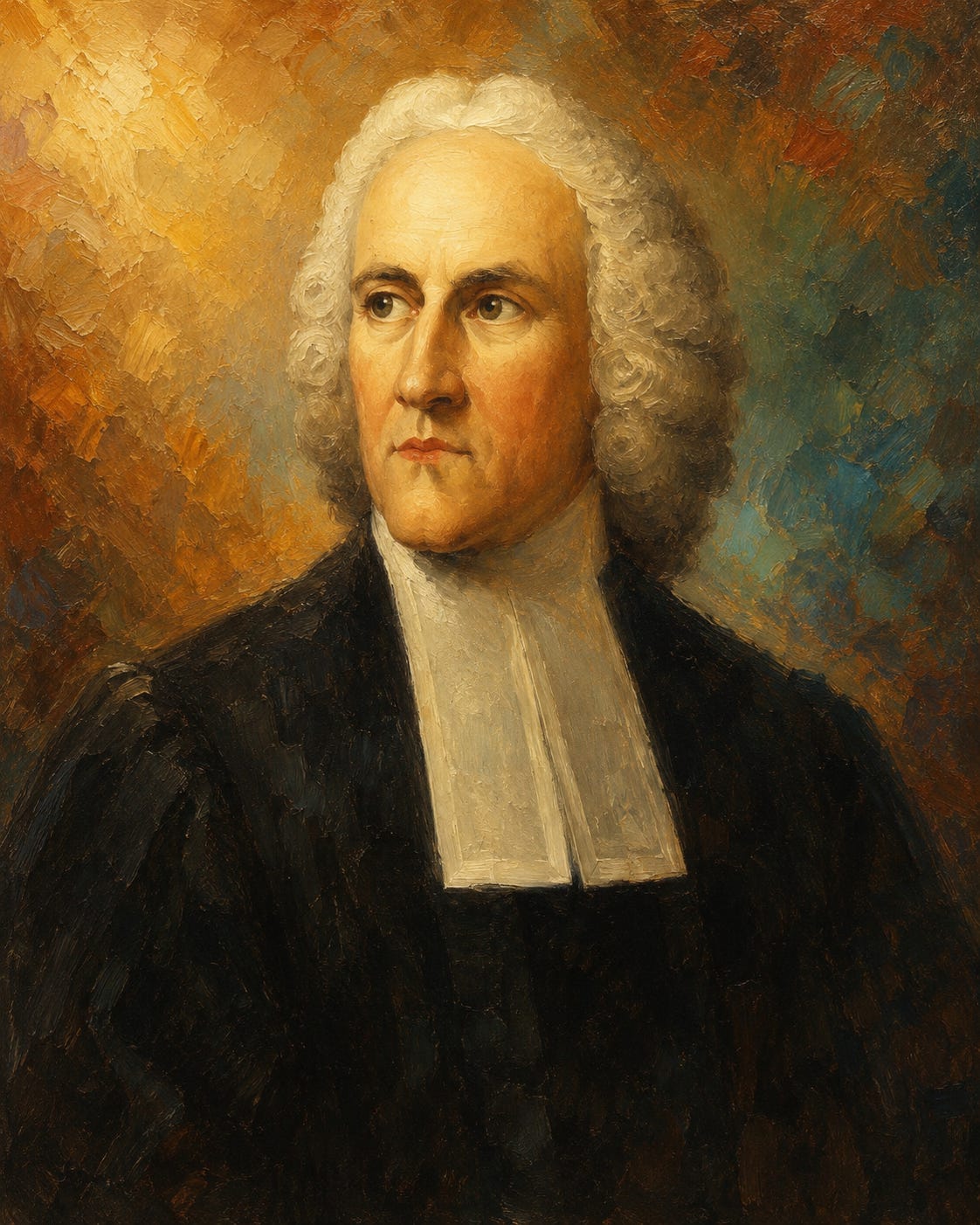
Who He Was
Jonathan Edwards was born in 1703 in East Windsor, Connecticut, the son of a Congregationalist minister. He was a prodigy in the most genuine sense, entering Yale at thirteen and demonstrating from an early age a philosophical curiosity that went well beyond the inherited categories of his tradition.2
